

This time we had the floorstanding Marten Oscar Trio in for review. Although it belongs to the Swedish manufacturer’s most accessible series, make no mistake – this is a high-end loudspeaker in every sense of the word.
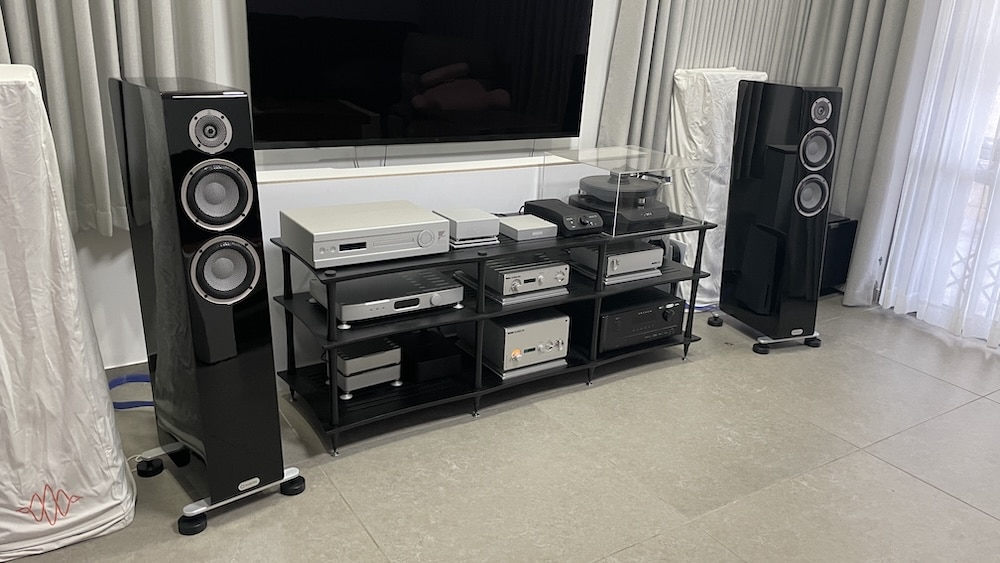
We thank Raguan Audio, the official Marten importer in Israel, for providing the speakers for this review.
Bottom Line
With its clean, minimalist Scandinavian design and remarkably well-balanced sound signature, the Marten Oscar Trio is one of the finest loudspeakers we’ve had the chance to review

Liked
- Meticulous construction with high-quality, elegant finishing
- Exceptional balance between detail and speed on one hand, and softness and a pleasant presentation on the other
- High transparency without dryness or excessive analyticity
- Excellent dynamics that hold up even at low listening volumes
- Easy to drive – friendly to a wide range of amplifiers

To Improve
- I found the bass to be exceptionally clean, precise, and detailed, but listeners who prefer a more pronounced low-end may find it a bit too balanced or polite for their taste
About Marten
Marten was founded in Sweden in 1998 by Leif Mårten Olofsson, driven by a deep passion for music and for faithfully reproducing sound.
Leif’s grandfather, Josef Olofsson, was a violin maker inspired by Antonio Stradivari in the early 20th century, so you could say that music truly runs in the family. Leif himself began building speakers back in the 1970s, with a clear vision: creating loudspeakers capable of reproducing natural sound with full transparency and without coloration.
Marten operates as a family-run business. Alongside Leif are his brothers, Jörgen and Lars, who hold key roles in the company. All Marten loudspeakers are manufactured entirely in Sweden, from cabinet construction to final assembly and testing, by a dedicated team of experienced specialists.
In 2014, Marten established a private recording studio at its headquarters in Gothenburg. Recordings made there later served as inspiration and reference material for the design of the company’s flagship line, the Coltrane Series.
Today Marten’s product lineup consists of four main series:
At the top is the prestigious Coltrane Series, followed by the Mingus Series, then the mid-range Parker Series, and finally the Oscar Series – the company’s most accessible and youngest line.
About the Oscar Series
The Oscar series was launched in 2019, and to me it represents Marten’s transition from an exclusive boutique manufacturer to a broader, more prominent audio company.
Many brands operate in a boutique production model, meticulous handcrafted work, a limited number of models, and exceptionally high build standards. In this model, the construction quality must be flawless to compete with the larger manufacturers, but prices often end up high due to production limitations.
When a company manages to find the delicate balance, maintaining the quality, design, and recognizable sonic signature it’s known for, while also bringing the price down to below the 10–12k USD range – that’s the moment it crosses the line from “boutique brand” to a global manufacturer that appeals to a wider audience.
This shift is also culturally significant: it allows a younger generation of audio enthusiasts, who appreciate high quality sound but can’t afford ultra high end prices, to get closer to what Marten has to offer.
So the question is: with the Oscar series, has Marten truly managed to preserve its core DNA – in quality, design, and sound, without sacrificing accessibility?
Let’s find out.
Under Review: Marten Oscar Trio
The Oscar series includes two models: the stand-mount Duo and the floor-standing model reviewed here, the Oscar Trio. The Trio is a 2-way loudspeaker featuring a 1-inch ceramic dome tweeter and two 7-inch ceramic mid-bass drivers. These drivers were developed specifically for this model and offer exceptionally low distortion, allowing the speakers to achieve high dynamic performance. While using the same material for both the tweeter and mid-bass units isn’t entirely unique, it’s still relatively uncommon. Since every material has its own sonic signature, using the same material across all drivers can result in a more uniform sound.
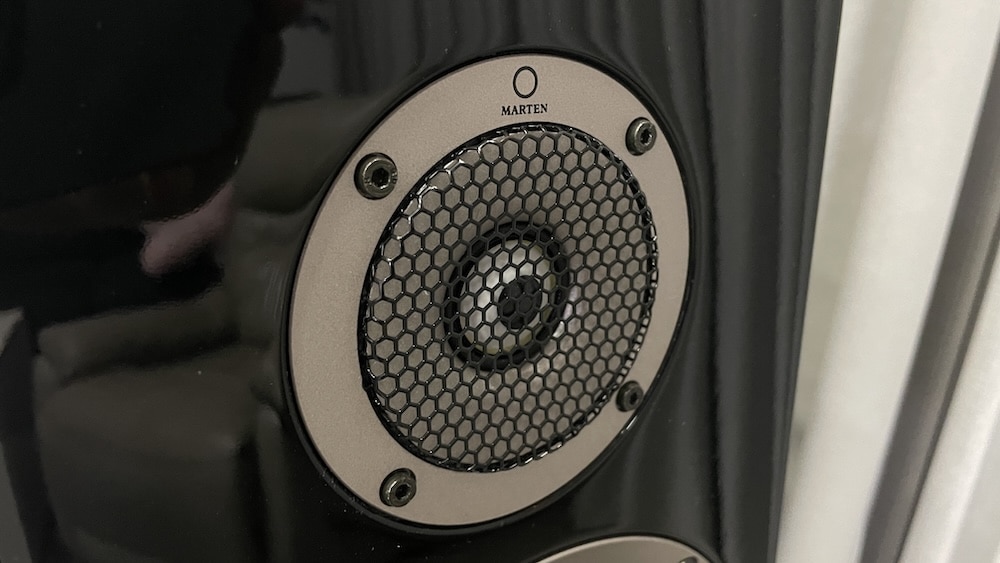
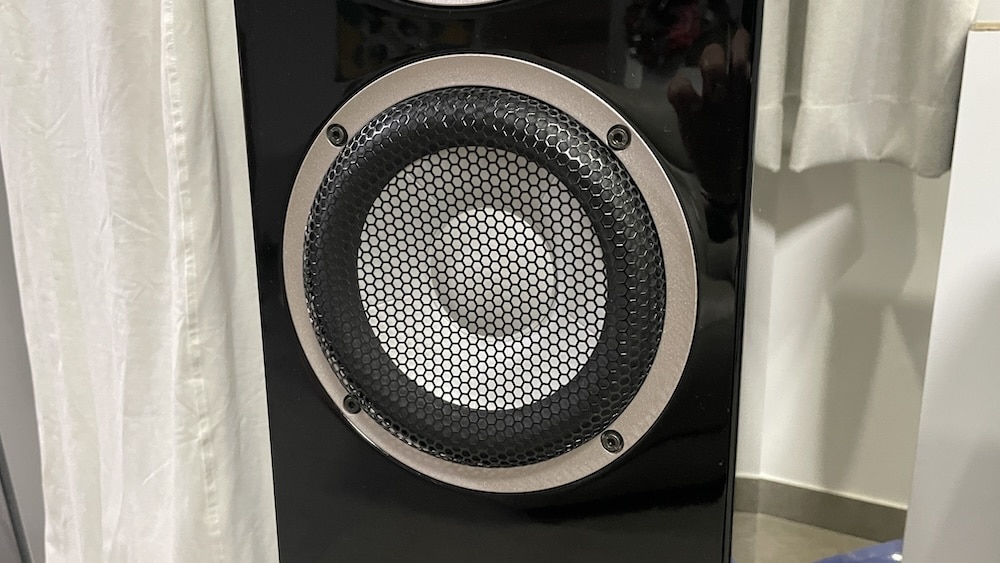
The crossover circuit uses high-quality components, such as copper foil air-core coils and Silver/Gold capacitors. The internal cabling comes from Jorma Design – also Swedish.
The cabinet is built from a material known as fibre laminate – multiple layers of fiber-based sheets. In this case, the panels are 25 mm thick. This material is considered stiffer and lower in resonance compared to MDF. The enclosure features an elegant backward tilt that helps achieve time alignment between all driver units.
The Marten Oscar Trio uses a single set of WBT Nextgen binding posts, compatible with all connector types.
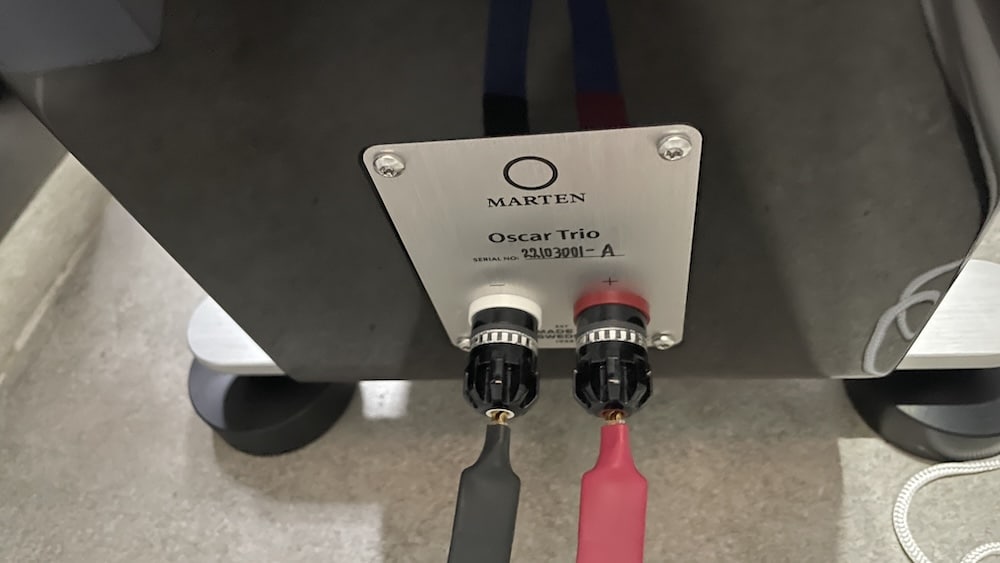
The enclosure is a ported design, with the port located at the bottom of the speaker.
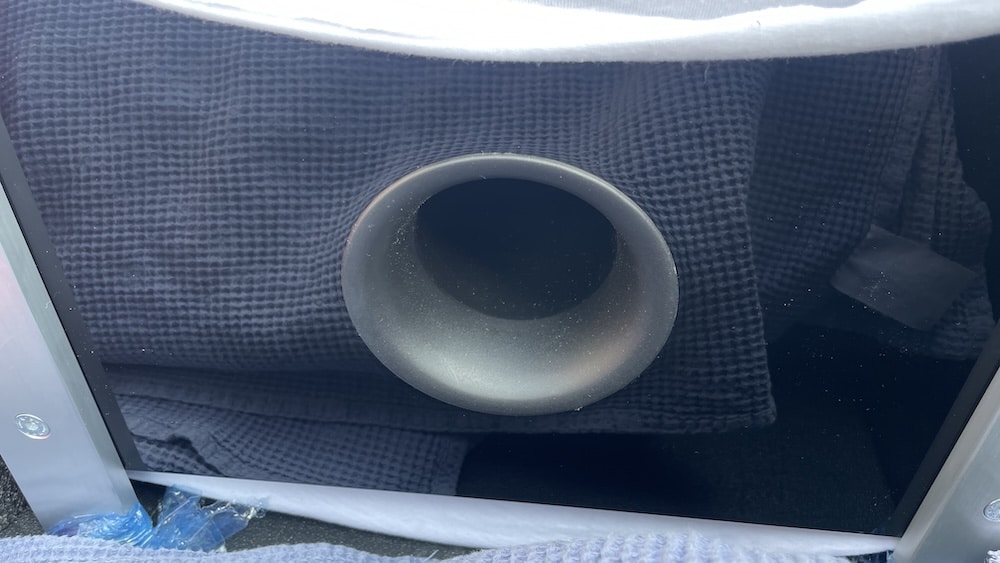
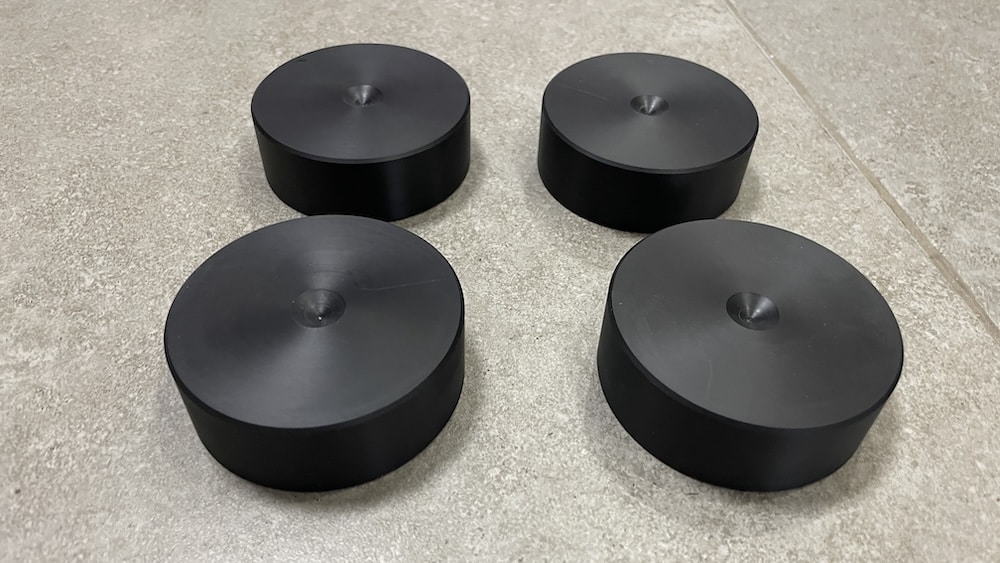
At the base, the speakers come with wide aluminum rails and spikes, and additionally include massive thermoplastic isolation feet – an investment rarely seen among most manufacturers. The combination provides impressive isolation from the floor, creates proper airflow for the down-firing port, and gives the speakers excellent stability.
Additional technical specifications:
Frequency response: 27 Hz – 20 kHz (±3 dB)
Sensitivity: 89 dB
Nominal impedance: 6 Ω
Minimum impedance: 3.1 Ω
Crossover: 2nd order, crossover point at 2500 Hz
Cabinet dimensions (cm): 20 W × 109 H × 40 D
Weight: 30 kg per speaker.
To learn a bit more about the Marten Oscar Trio, and with the help of the official importer Raguan Audio, I have sent a few questions to Mr. Martin Dunhoff, Marten’s Head of Sales.
I couldn’t find any mention on your website about the port location. Can you explain why you chose a bottom-firing port and what advantages it brings?
"For every floor-standing design we make, we choose a bottom-firing port. The advantage is that it gives us precise control over the distance between the port and the floor, which makes it easier to achieve the desired result and simplifies speaker placement — unlike a rear port, which depends heavily on the distance to the wall. An alternative we have used in other ranges (such as Parker) is a passive radiator; with careful design, both approaches can deliver excellent results."
Are the drivers manufactured by Marten or by a third party?
"The drivers are manufactured by a specialist company, built to Marten’s exact specifications specifically for the Oscar series."
What room size are the Oscar Trio intended for?
"The Oscar Trio perform best in listening rooms of approximately 20–30 m², although the final results always depend on the room’s acoustics"
Are the Oscar speakers named after the jazz pianist Oscar Peterson?
"All of Marten’s speaker series are inspired by jazz musicians."
Design and Build Quality
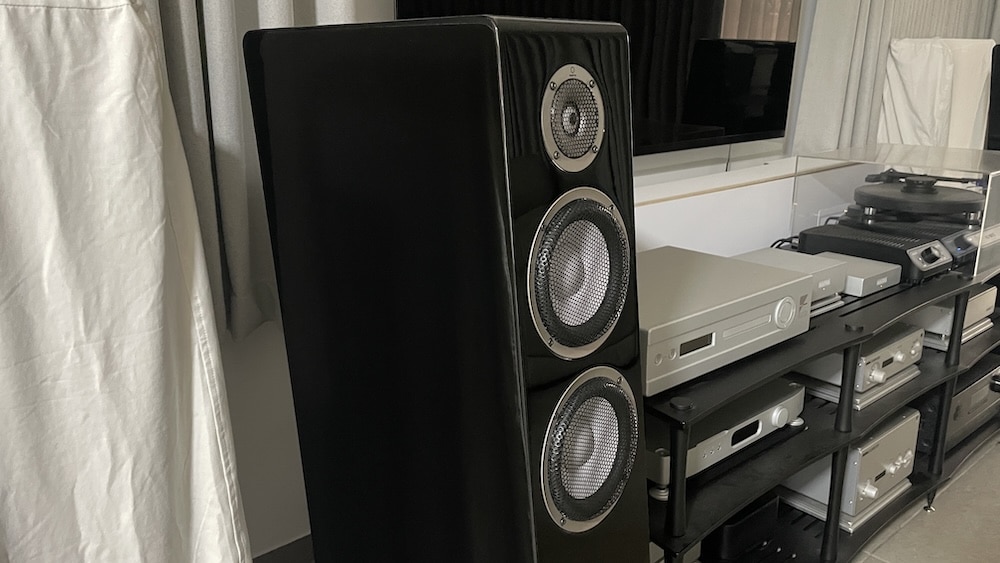
The Oscar series models are available in three finishes: matte walnut, piano black, and piano white. The pair I received came in the piano-black finish. I’ve mentioned before that this finish is not one of my favorites, as it tends to be very reflective, which can be distracting when watching TV, and it shows dust and fingerprints easily. That said, Marten’s implementation of piano black is one of the most refined and balanced I’ve seen. It’s glossy and impressive, but not overly shiny or loud, conveying a sense of luxury with that signature Scandinavian elegance.
This balance and elegance also come through in the minimalist design. At the base of the cabinet there’s a subtle Marten badge, with another small inscription around the tweeter frame. Beyond that, the design is completely clean.
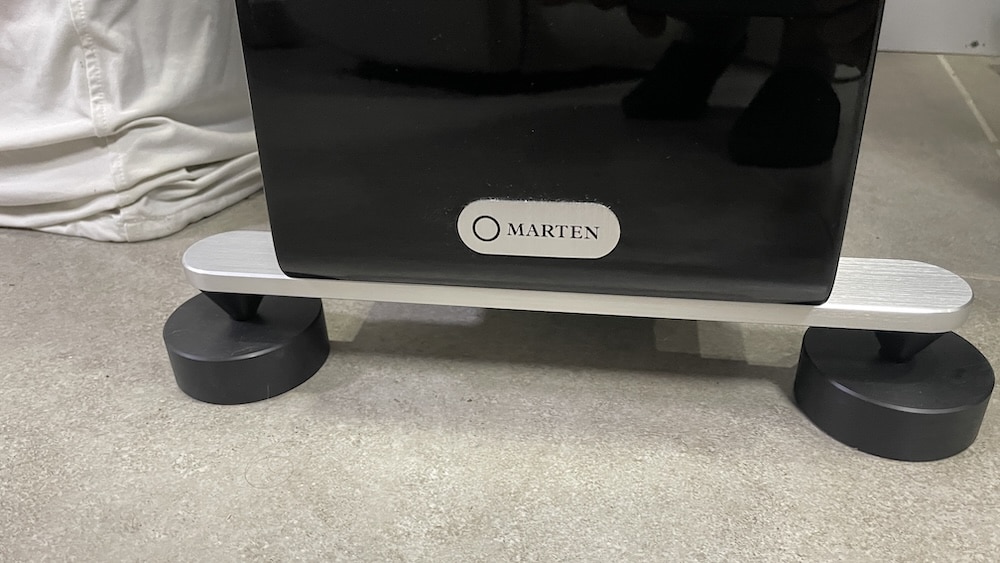
I particularly liked the combination of the metallic-grey driver cones with the black cabinet. Together with the backward tilt, it gives the speaker a sense of visual flow and lightness.
The drivers are protected by fixed metal grills – a common solution for ceramic drivers – offering effective protection without compromising the look.
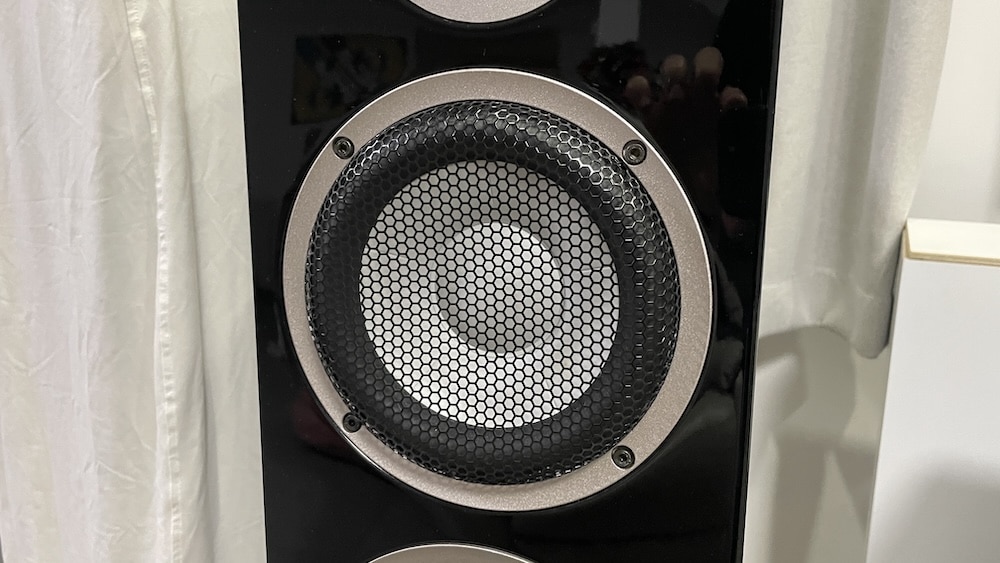
The feet and terminals also contribute to the speaker’s feeling of maturity and luxury. With their slim, tall profile, the Oscar Trio feel relatively compact, fit naturally into a typical living room, and look perfectly proportioned – not too small, not overly dominant.
The Listening Test
Speaker Placement and First Impressions
During the first few evenings, I listened to the Marten Oscar Trio rather casually, including a full day of break-in, using my usual jazz and blues playlists. The speakers were initially placed almost identically to my reference pair, the YG Acoustics Vantage 3, with a slight inward angle to create toe-in toward the listening position. After a few tracks, I noticed a slight imbalance, the left speaker felt a bit more dominant. A small adjustment to the right speaker (adding just a touch more toe-in) solved the issue, and the presentation snapped beautifully into place. Overall, positioning the speakers turned out to be a very straightforward task.
The system I used included the Nagra Classic Int integrated amplifier, the MSB Discrete DAC with two external power supplies, and the Nagra Streamer as the source. Later on, I also brought in the SME Model 12 MK2 turntable with the Phasemation PP-200 cartridge and the Nagra VPS phono preamp (full system details appear at the end of the review).
During casual listening, I usually pay attention to the sonic traits that naturally catch my ear—those often indicate what I should focus on during the critical listening stage. My very first impression of the Oscar Trio was, above all, a strong sense of musicality. It’s a somewhat elusive and subjective concept, but for me, it means having no desire to analyze the sound technically; instead, I simply sink into the music and enjoy it.
Ease of Drive and Performance Across Volume Levels
Before diving into the details of the listening experience, it’s worth highlighting two standout characteristics of the Oscar Trio.
The first is their ease of drive. With a sensitivity of 89dB and a nominal impedance of 6 ohms, these speakers don’t require a particularly powerful amplifier to perform at their best. While the Nagra Classic Int is an exceptionally high-quality amplifier rated at 100 watts per channel into 8 ohms, it’s far from the most powerful option on the market. Paired with the Oscar Trio, the result was twofold: on one hand, the speakers place very little strain on the amplifier, allowing it to operate comfortably within its optimal range; on the other hand, the Oscar Trio’s high level of transparency allows them to reveal the amplifier’s refined sonic qualities with impressive accuracy.
The second characteristic is their consistent performance at different volume levels. Many speakers lose some bass presence and overall dynamics at low volumes, while at higher volumes they may begin to sacrifice cleanliness and separation. The Oscar Trio, however, offers an unusually wide operational sweet spot: they maintain excellent dynamics and energy even at low listening levels, making the music feel alive, and they can be pushed to higher volumes without any notable decline in clarity or separation.
Breaking Down the Sound: Key Traits and Listening Examples
In the core part of the listening test, I wanted to break down the idea of “musicality”, a quality that stood out so clearly during the first days with the Oscar Trio, and illustrate it through a few musical examples. I’ll admit that musicality wasn’t the first word I expected to associate with the Marten Oscar Trio. Typically, I reserve that term for more classic-sounding speakers: softer, more organic in character, often using paper drivers with high efficiency, usually paired with tube amplification.
The Oscar Trio, however, belongs to a very different world – they are thoroughly modern speakers built around ceramic drivers. Ceramic material is known for its exceptional rigidity and low mass, properties that enable fast transient response, high transparency, and impressive detail retrieval. In fact, the speed and cleanliness of these drivers approach the performance of electrostatic speakers. But as is so often the case in audio, it all comes down to balance. A speaker that delivers extreme transparency and detail can easily lean toward dryness or become overly analytical, almost studio-like.
This is precisely where Marten’s engineers excel: alongside the remarkable clarity and precision, they’ve managed to build in a sense of smoothness, a relaxed presentation, and a natural ease that makes the speaker genuinely pleasant to listen to.
For example, when listening to 707, the 2016 album by the German nu-jazz group Nighthawks, I heard an impressive blend of high energy, tight and punchy bass, and exceptional speed, yet none of it came at the expense of the album’s inherent smoothness and flowing character. The brass instruments sounded clean and precisely defined, without any harshness, and the drums had body and warmth – far removed from anything that could be described as “analytical” or “dry.”

To test male vocals, I moved on to the energetic blues track Sometimes I Cry by Chris Stapleton. His powerful, gritty voice was rendered with exceptional detail, including that hint of natural distortion that characterizes his tone. The bass was once again tight yet never rigid, striking a perfect balance between impact and softness, and the guitar was well-separated and clear, almost three-dimensional in its presentation.
Next, I moved on to evaluate female vocals with Willow Weep for Me by singer Lizzie Thomas, accompanied by the legendary bassist Ron Carter. This track is exceptionally minimalistic – just voice and bass, so every small detail carries weight. The bass was rich, deep, and remarkably dynamic, while the vocal was sweet, clear, and distinctly separated. Despite the drivers fast response, you could clearly hear the natural resonance of the bass lingering in the air exactly as captured in the recording – a clear testament to the speakers impressive transparency. The level of cleanliness and black background here was flawless.
Moving on to another acoustic piece, Vada by the folk duo Amistat from their 2020 live album Amistat (Live), the Oscar Trio demonstrated an impressive ability to convey the feel of a live performance. The guitar picking was delicate yet rich in detail, even in the quietest passages. The dynamics were once again impressive, precise yet balanced and the dual vocals sounded airy and pleasant. The body-percussion on the guitar was energetic and well-defined, adding a wonderful sense of liveliness to the piece.
I wrapped up this section with an energetic electronic track, Recognizer by Daft Punk. It’s one of the best pieces for testing micro-dynamics, and the Oscar Trio conveyed the gradual build-up with remarkable precision. Layer separation was excellent, and the dynamics were impressive without ever feeling overdone. The bass grew steadily in intensity, yet always remained controlled – never overly tight or lean. It may not have been the most powerful bass I’ve heard, but it was certainly among the most detailed, clean, and well-balanced.
And finally, a word about soundstage reproduction. While some speakers try to “paint” the stage and artificially widen it, the Marten Oscar Trio simply reflect what’s in the recording. When the stage is intimate, they present it that way; when it’s wide and three-dimensional, they reveal its full depth. This is audiophile realism at its finest.
Vinyl
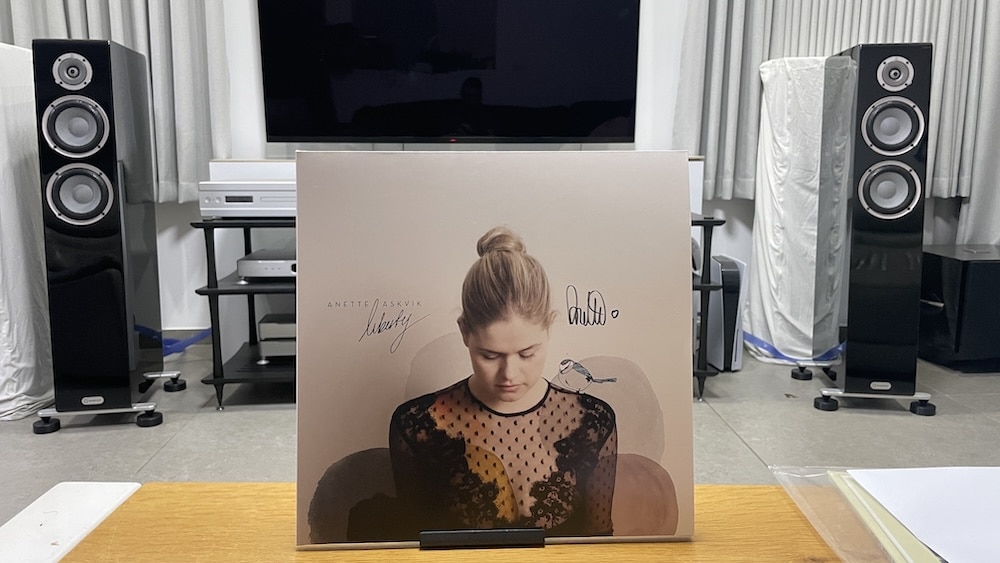
In the final part of the listening test, I switched to analog, wanting to understand how the Marten Oscar Trio handle a completely different format. I started with a special record I purchased at the 2025 Munich show: a 180-gram, 45 RPM edition of Liberty by Norwegian singer Anette Askvik (complete with her personal signature). It’s an audiophile album in both recording and pressing, and what I heard here was essentially the essence of the analog experience at its best. On the title track, I received a phenomenal level of detail, you can practically feel the moisture in Anette’s mouth as she sings. Alongside the subtle effects, the bass dynamics and punch, the balance and smoothness were beautifully preserved. The saxophone solo was clear, powerful, and full of life. The presentation of this piece was – and I don’t use this word often – close to perfect.
With the second record I decided to challenge the Oscar Trio with a less “audiophile” record from my collection: Plays Well With Others by Lera Lynn. It’s an excellent acoustic album, but its pressing is of slightly lower quality, with a rather flat stage and a somewhat two-dimensional sound. The goal was clear: to see whether the speakers would be less forgiving with such material. I listened to the opening track, Same Old Song, and indeed the soundstage was less three-dimensional. However, I was genuinely surprised by the level of dynamics, and the overall presentation was so pleasant that I found myself sitting and listening to the entire first side of the record.
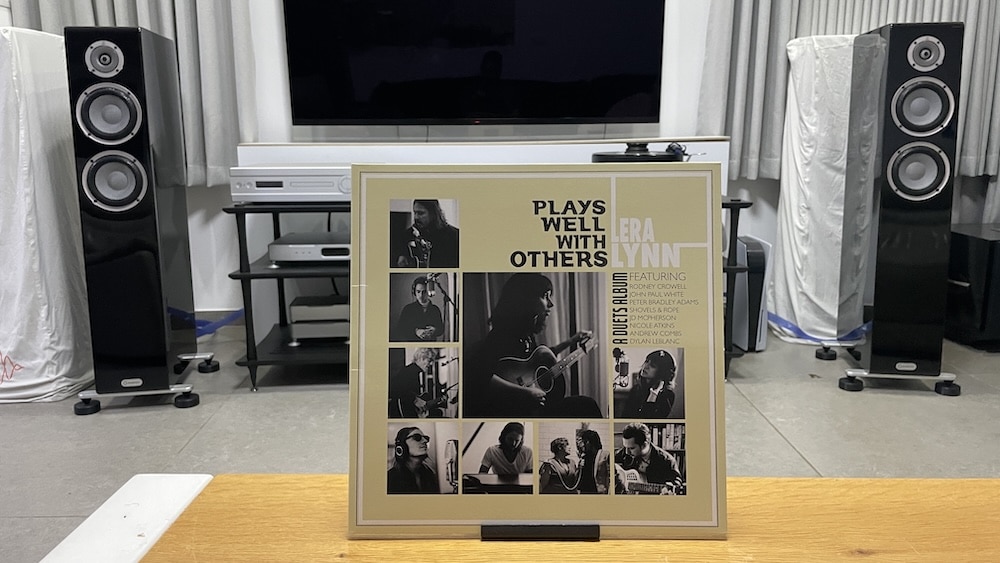
It’s clear that the Oscar Trio are not magicians – they didn’t transform the pressing into an audiophile masterpiece. But on the other hand, they also didn’t exaggerate its weaknesses. This is an important point: they are transparent, but not overly judgmental.
?Are the Marten Oscar Trio a perfect loudspeakers
Throughout the entire listening test, I genuinely struggled to find any significant shortcomings in the Marten Oscar Trio, which naturally raises the question: is this a perfect loudspeaker?
Well, I don’t believe that a perfect product exists in audio. Preferences are subjective – every listener has different tastes, and there is no single sound signature that suits everyone. In the case of the Oscar Trio, what created such an enjoyable experience for me was a combination of three factors: an excellent match with my personal taste, a precise fit for the size of my listening space, and outstanding synergy with my system. This rare alignment is exactly what made my time with these speakers so special.
Summary
When I try to summarize my experience with the Marten Oscar Trio, the word that keeps coming back is balance. This may be the quality that defines them more than anything else – both in their design and in their sonic performance. The Oscar Trio demonstrated a balance between accurate, fast and detailed sound, and a smooth, gentle and natural presentation. This ability to blend both worlds without tipping toward the analytical or the romantic side is, in my view, the main reason they impressed me so much.
Over the years, I’ve reviewed many excellent products across all price ranges. Only a few have left an impression that stayed with me long after the review was finished. The Oscar Trio are without question part of that very small group. They’re not just excellent speakers “for the price” – they’re simply excellent speakers, period.
Price: 54,000 NIS
Warranty: 3 years
Importer: Raguan Audio
The system I used for the review:
DAC: MSB Technology Discrete DAC with dual power supplies
Integrated Amplifier: Nagra Classic Int
Turntable: SME Model 12 MK2
Cartridge: Phasemation PP-200
Phono Pre-amp: Nagra VPS
Streamer: Nagra Streamer with Nagra Compact PSU
Cables:
XLR cable between the DAC and Amp: Nordost Blue Heaven
RCA cable between the turntable and the phono : + Nordost Blue Heaven Tonearm Cable
RCA cable between the phono and the amp: Nordost Blue Heaven
Coaxial cable between the streamer and DAC: Nordost Blue Heaven
Speaker cables: Nordost Blue Heaven
Power:
Power cables for the Streamer, amplifier and DAC : Nordost Blue Heaven
Power Distribution Block : QBASE QB8 Mark II (to it the Streamer, amplifier, DAC and CD player were connected)
Power cable for the distribution block: Nordost Red Dawn
Audio Rack: Quadraspire SV3T Performance