


This time we had the opportunity to review a luxury integrated amplifier from Switzerland: the Orpheus Lab A Four I200. In this review, we will explore whether it is possible to achieve ultra-high-end sound while maintaining the convenience and minimalism of an integrated amplifier.
We would like to thank Raguan Audio, the official importer of Orpheus Lab in Israel, for providing the amplifier for the purpose of this review.
Bottom Line
The Orpheus Lab A Four I200 is a powerful, precise, and emotionally engaging integrated amplifier that offers a compelling and cost-effective alternative to ultra high-end separates

Liked
- Excellent build quality combined with an elegant and clean design
- Premium dual-mono architecture with two large toroidal transformers
- Generous connectivity: 3 XLR inputs and 3 RCA inputs
- Power output capable of driving almost any loudspeaker with ease, with outstanding bass control
- The amplifier’s power and control are beautifully balanced with a smooth and emotionally engaging presentation

Improvement Points
- No option to configure an input as HT Bypass for integration into a multi-channel home theater system
About Orpheus Lab
Orpheus Lab is a Swiss manufacturer of high-end audio equipment, founded in 2001 and based in the Yverdon region of Switzerland. The company operates in the spirit of Swiss precision and craftsmanship, much like the country’s renowned watchmaking industry, placing a strong emphasis on the combination of advanced engineering and meticulous hand assembly. Orpheus Lab products are designed, developed, and assembled entirely in-house, allowing the company to maintain full control over every stage of development and production. This approach helps ensure consistently high quality, tight integration between hardware and software, and continuous refinement over time.
The history of Orpheus is closely connected to the Swiss digital audio industry, particularly through its founders, who were previously involved in the development of advanced DSP technologies. Today, the company offers a full range of high-end audio electronics, including CD and SACD players, digital-to-analog converters, integrated amplifiers, preamplifiers, and power amplifiers. The main product lineup is divided into two series: the Absolute series and the flagship Heritage series.
Under Review: Orpheus Lab A Four I200
The Orpheus Lab A Four I200 is the only integrated amplifier in Orpheus Lab’s current product lineup. The amplifier is built around a true dual-mono architecture, in which each channel operates as an independent system with its own dedicated power supply. Each channel is powered by a large 880VA toroidal transformer, a design intended to maintain high voltage stability even under demanding dynamic loads.
The amplification stage itself uses six hand-matched MOSFET transistors per channel, driven by a BJT-based driver stage. This combination allows for precise control of current and feedback while maintaining a balance between strong technical performance and a natural, musical character.
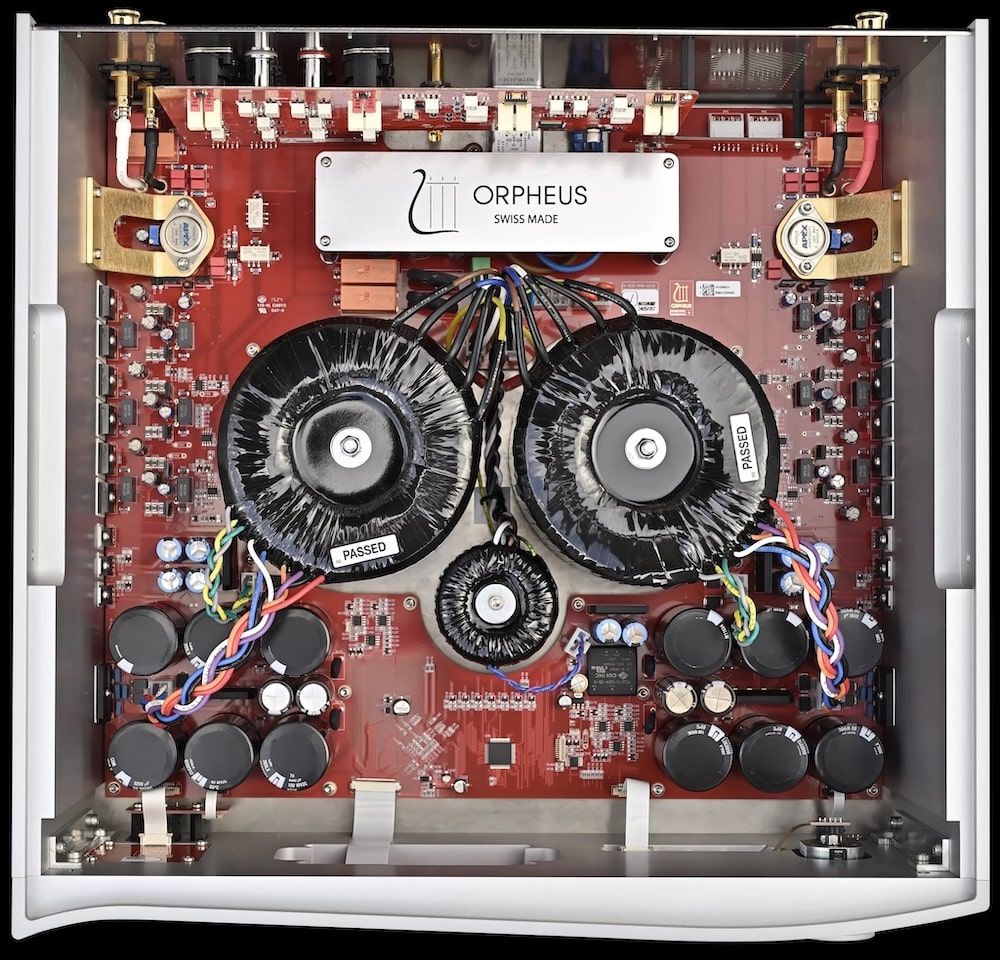
The A Four I200 operates in Class AB and delivers 200 watts per channel into 8 ohms, with a peak power capability of up to 850 watts. A bias current of approximately 125mA helps ensure thermal stability and consistent sonic performance over time.
The frequency response is exceptionally wide, ranging from approximately 0.7Hz to 85kHz, with very low distortion of around 0.004% at full power – figures that reflect a design focused on maintaining transparency and dynamic capability. In addition, a damping factor of over 3000 ensures strong control and tight grip over virtually any loudspeaker on the market.
In terms of connectivity, the amplifier offers six inputs in total: three unbalanced RCA inputs and three balanced XLR inputs. Each input allows the user to select between three sensitivity settings (High / Medium / Low). On the front panel there is also a dedicated headphone output, capable of driving headphones with impedances ranging from 32 to 600 ohms.
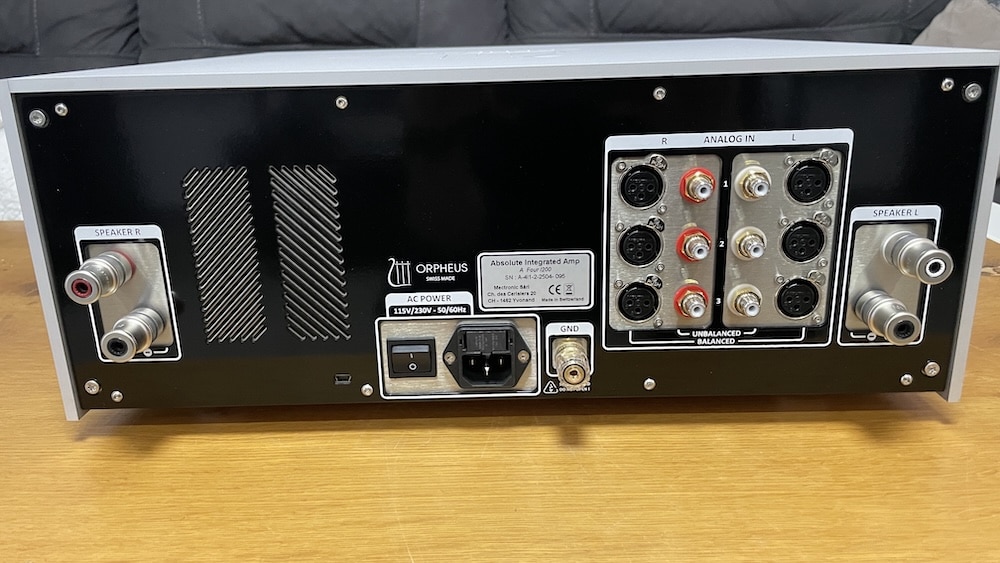
The number of inputs is generous. However, one feature I personally found missing is a pre-out output, or a dedicated subwoofer output.
The volume control mechanism is based on the PGA2320 chip, an analog, digitally controlled solution chosen for its high precision and its ability to maintain excellent channel balance across the entire volume range.
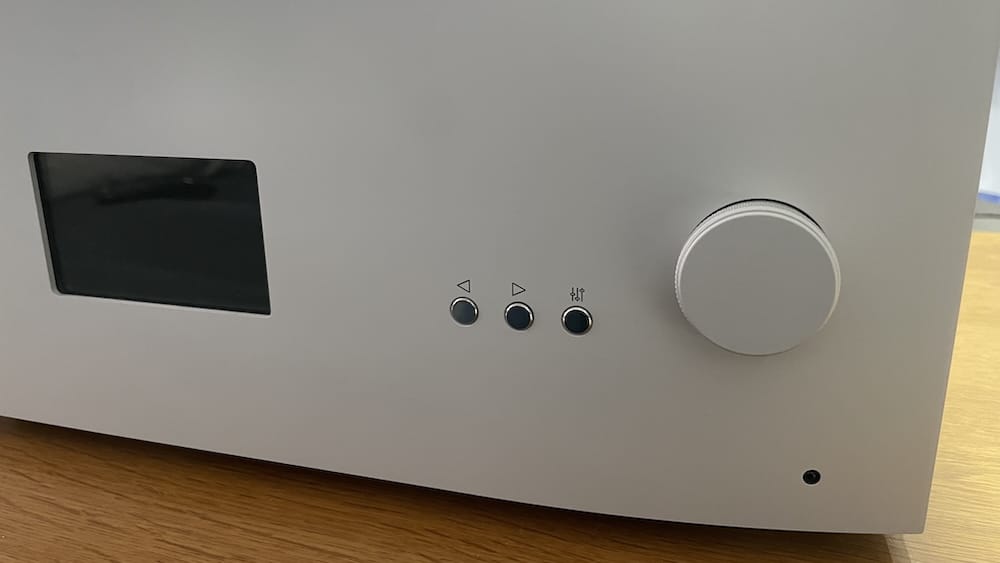
The amplifier measures 440mm wide, 420mm deep, and 179mm high, and weighs 36kg, making it a decidedly substantial piece of equipment.
Design and Build Quality
A brief unboxing in photos:
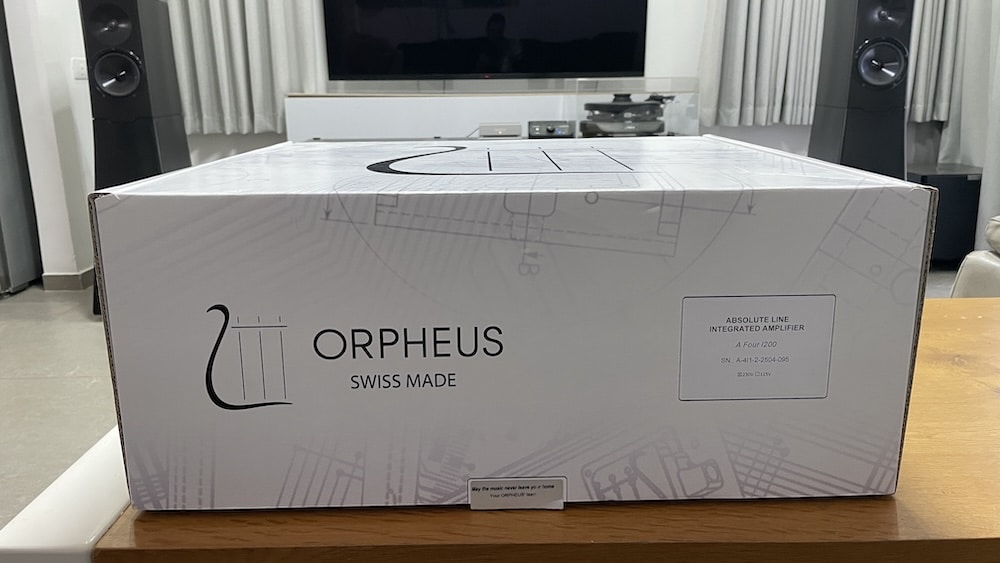
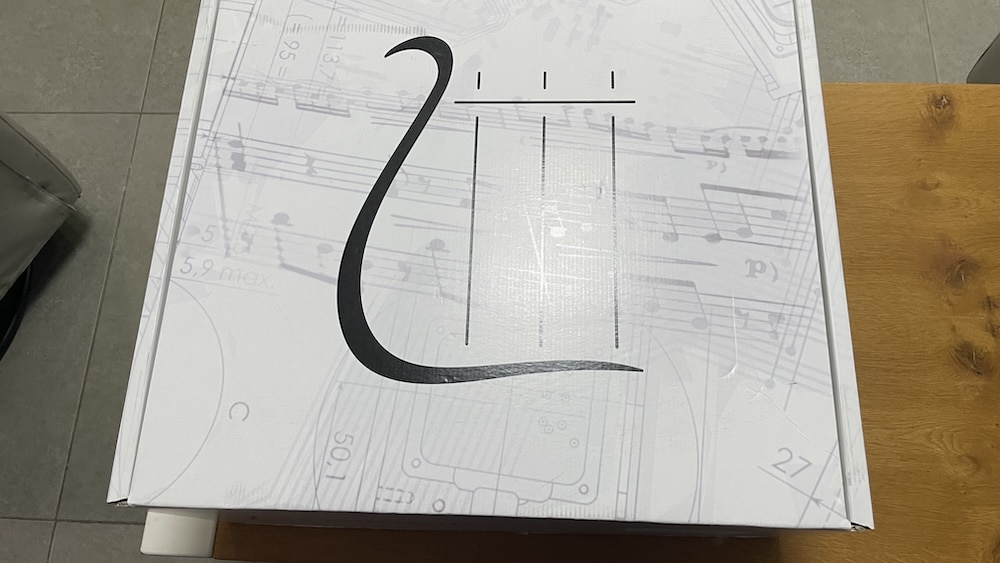
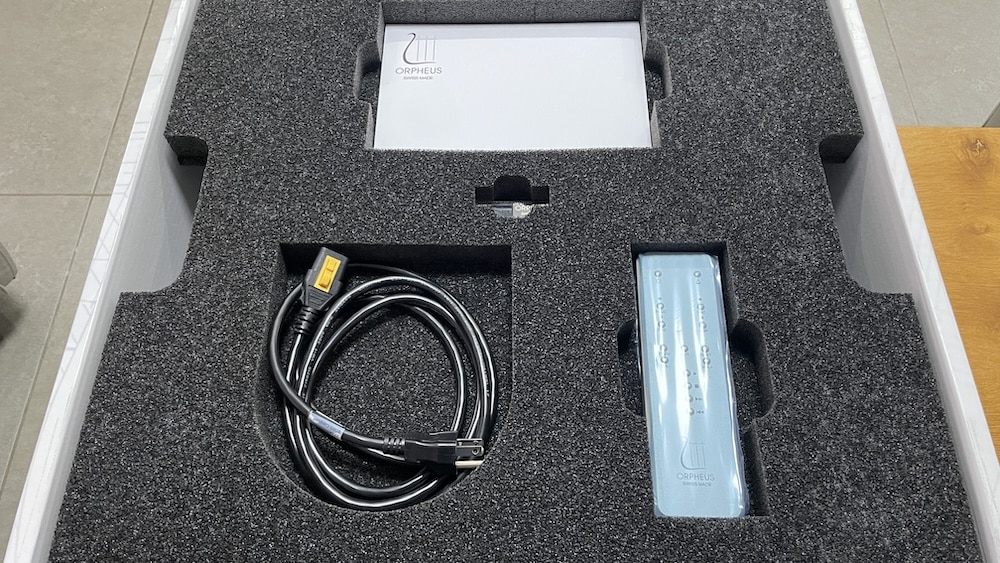
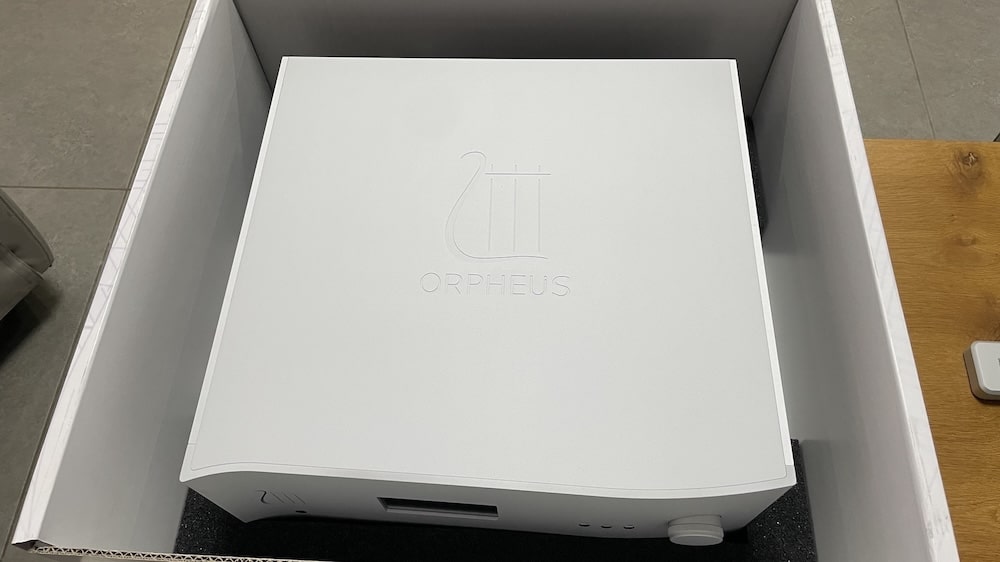
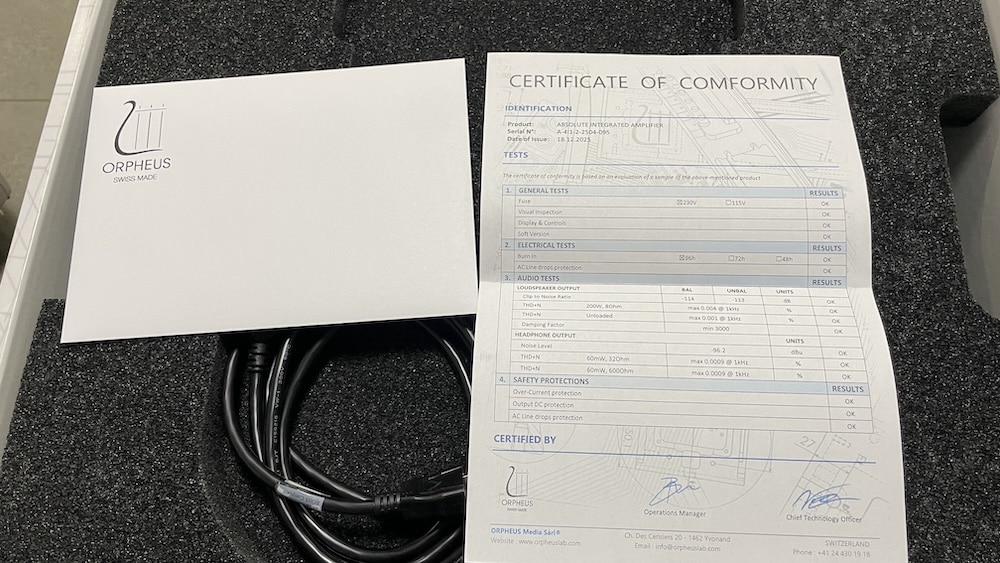
There is no doubt that Orpheus Lab invests considerable effort in creating a premium experience starting already at the packaging stage. I especially liked their slogan: “May the music never leave your home”, which appears on a sticker on the box. Inside the package you will also find an envelope containing a test certificate confirming the quality control procedures the unit has undergone, including the signature of the technician who inspected it.
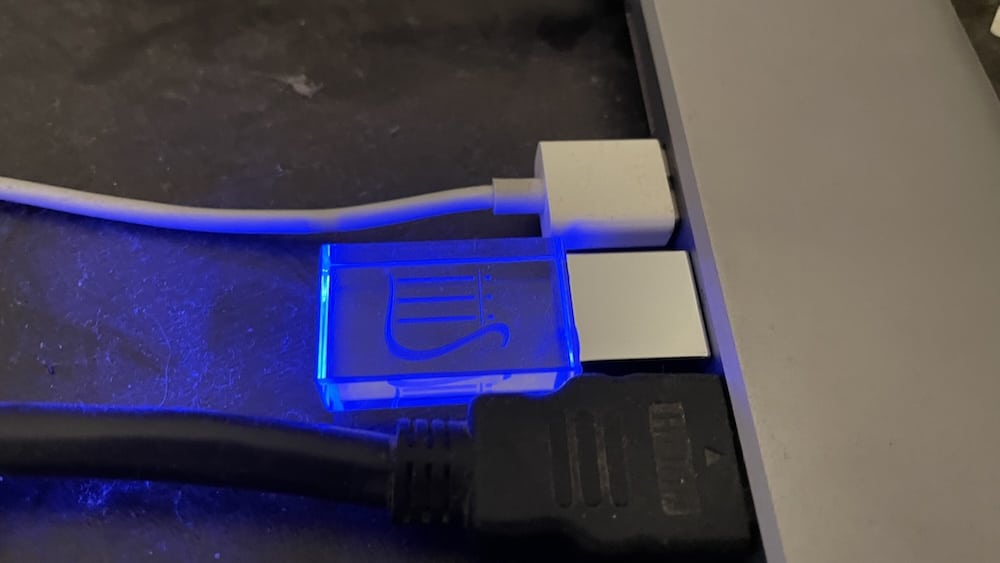
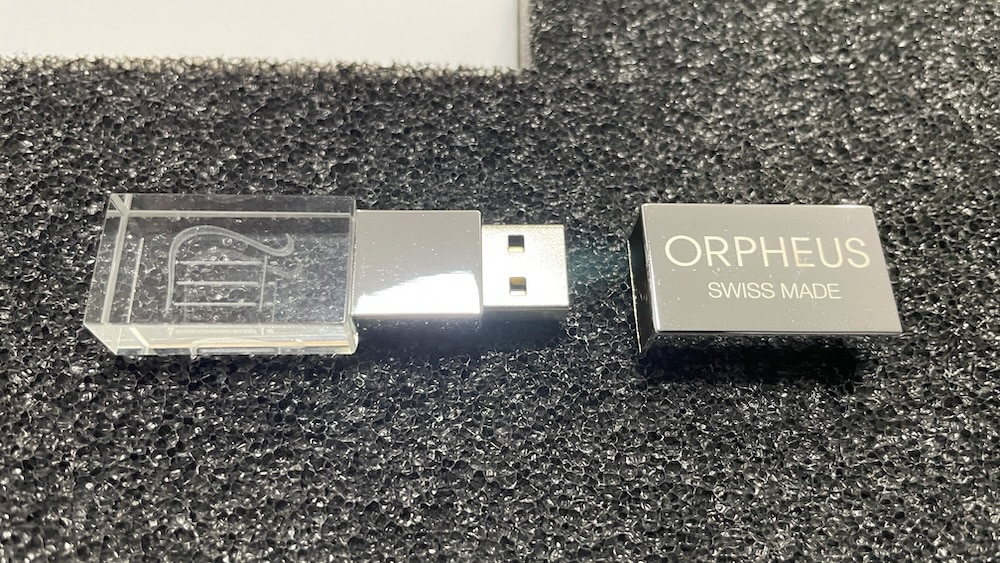
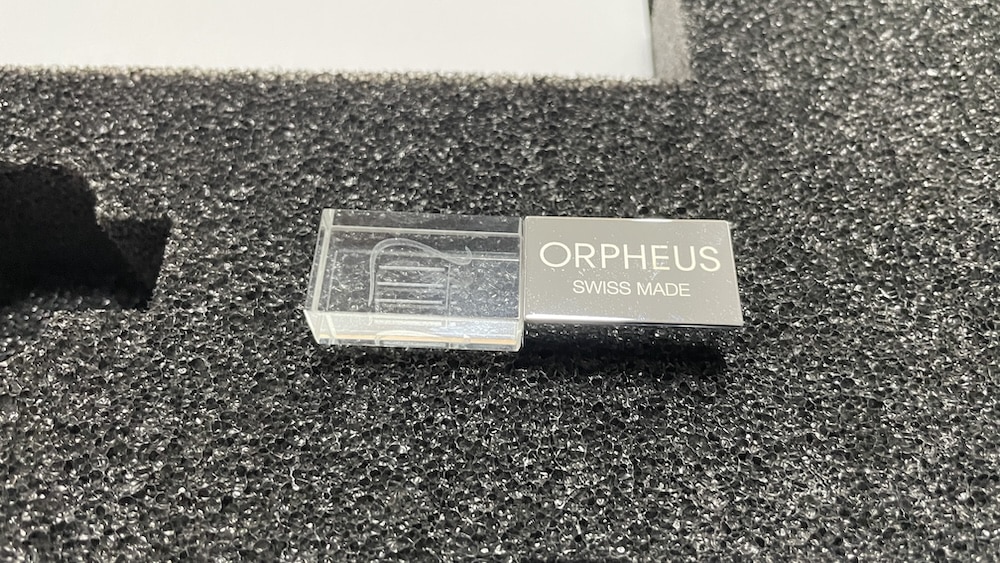
Together with the amplifier, the company also provides a beautifully designed USB stick. It is a small detail, but one that reflects the level of attention Orpheus Lab gives to the overall experience. When connected to a computer, the USB drive even illuminates in the distinctive blue color associated with the brand. Among the files stored on it you will find drivers for the company’s CD players, as well as the user manual.
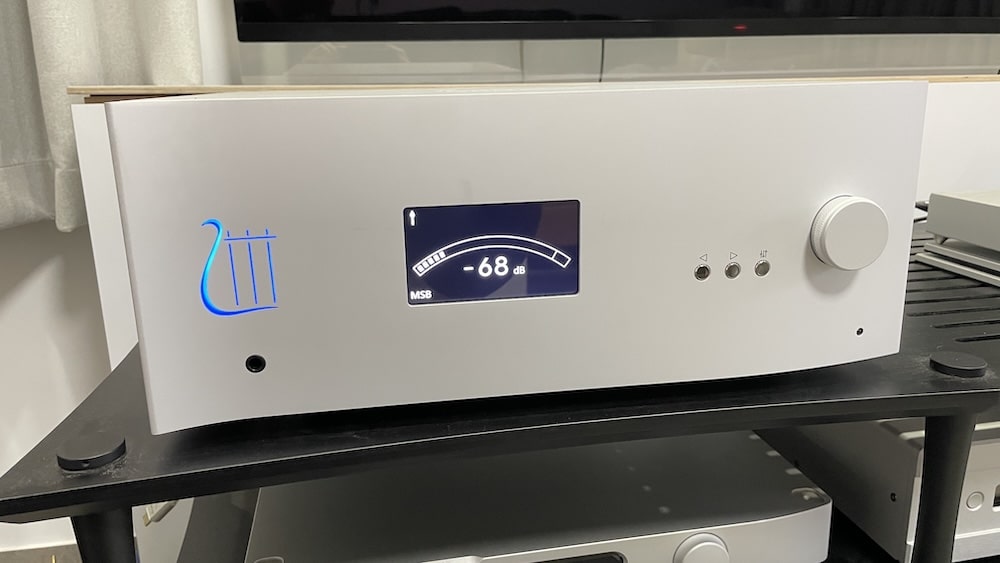
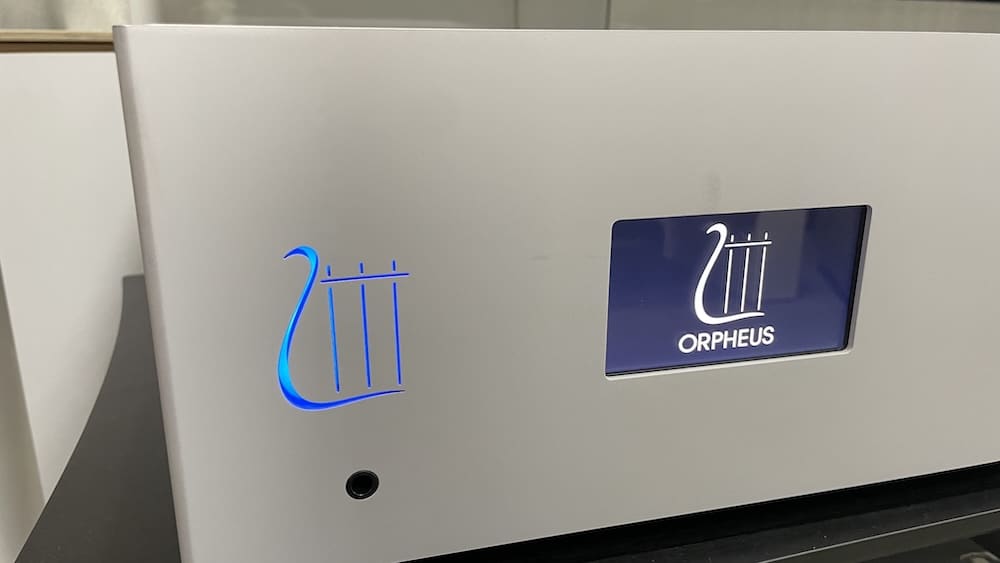
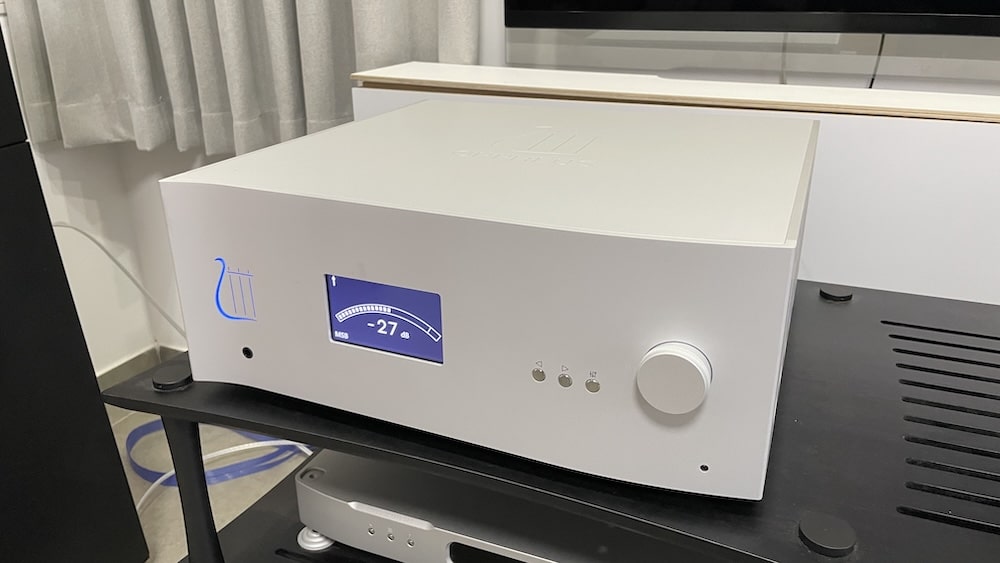
As mentioned earlier, this is a fairly massive amplifier – and the larger and heavier the amplifier, the greater the design challenge in maintaining a balanced and aesthetically pleasing appearance. In my view, Orpheus Lab has handled this challenge very successfully. The gentle curvature of the front panel conveys attention to detail and even somewhat recalls the elegant curve of a high-end piano. Instead of a small indicator LED on the front, the company chose to prominently integrate its characteristic harp logo: it glows red when the amplifier is in standby mode and blue when the amplifier is operating.
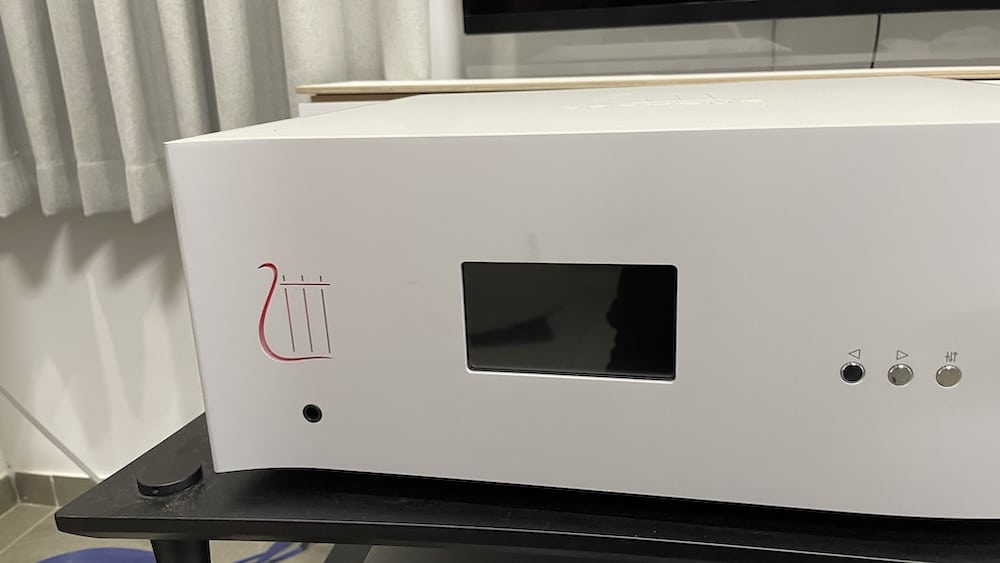
The refined gray metallic finish, together with the large logo on the top panel, completes the overall appearance. It is clear that a great deal of thought went into the design, yet it is executed with restraint and maintains a clean aesthetic. If I had to summarize the design language of the Orpheus Lab A Four I200 in a single word, it would undoubtedly be elegance.
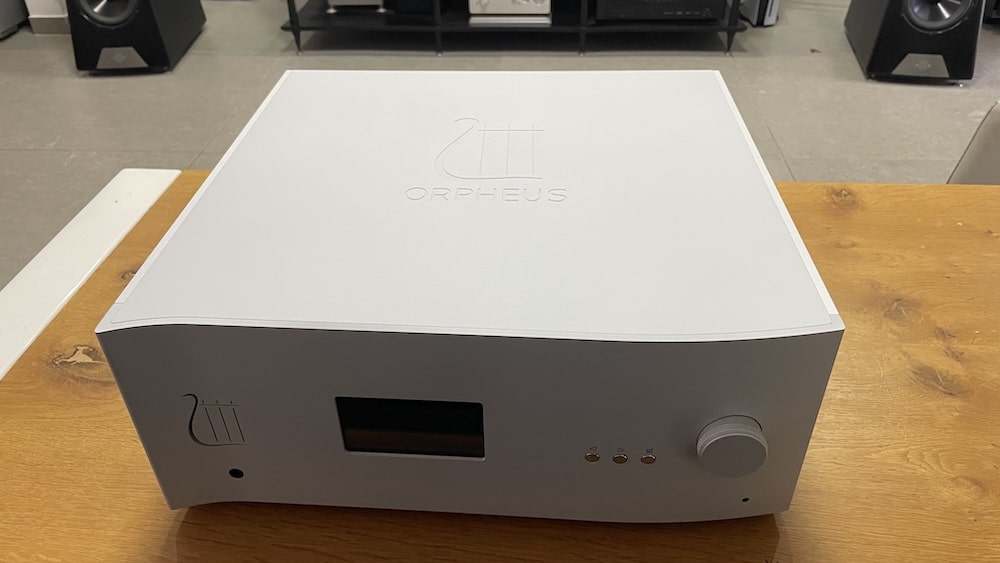
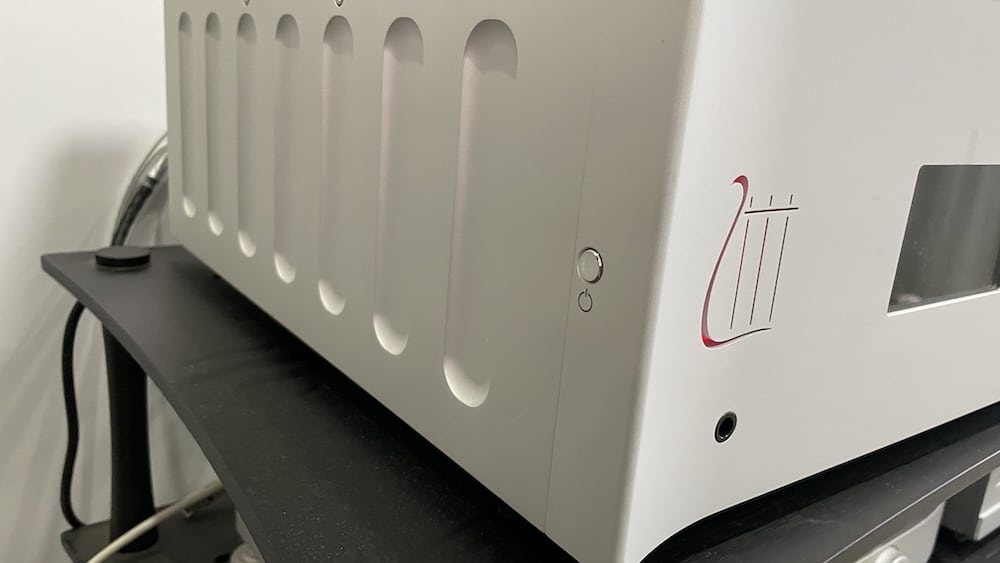
That said, I do have two small remarks. First, I am not entirely sure why the power switch is located on the side of the unit. In some tube amplifiers it is common to hide the power switch to prevent accidental activation, while in other amps the goal is to simply keep the front panel completely clean of buttons. Here, since this is not a tube amplifier and the front panel already includes several buttons, the decision feels slightly less intuitive to me.
The second point relates to the display. While it is functional and clear, the font quality and the way the screen is integrated into the front panel do not, in my opinion, convey quite the same level of premium feel that characterizes the rest of the amplifier.
When it comes to build quality itself, however, it is difficult to find much to criticize. Everything feels solid and meticulously constructed at a very high level – from the chassis and the large heat sinks on the sides, to the buttons and volume selector, and even the feet on which this heavy and impressive amplifier rests.
Control & User Experience
Control and usability in the Orpheus Lab A Four I200 are extremely straightforward – almost minimalist. In practice, most interaction with the amplifier comes down to selecting the desired input and adjusting the playback volume. While there is a settings menu, it offers only a limited number of options: adjusting input sensitivity, assigning names to the inputs, setting the display brightness, and choosing between two grounding modes for the unbalanced inputs (Tied or Lifted).
It is entirely possible that some users may never enter the menu during the lifetime of the product – and in my view, that actually reflects thoughtful design. Orpheus Lab has clearly chosen an approach focused on operational simplicity, where the amplifier is designed from the outset to deliver high performance without requiring the user to navigate through numerous settings.
That said, if I allow myself a small criticism: since a menu with several options already exists, I would have liked to see the inclusion of an HT Bypass function, which would make it easier to integrate the amplifier into a multi-channel home theater system.
The A Four I200 comes with a large and heavy metal remote control that is shared across the company’s Absolute series components, including their CD players. This means that some of the buttons are not relevant for users who own only the amplifier. The build quality of the remote is impressive and it performs exactly as expected, but given the level of the product I will allow myself one more minor critique: in my opinion, the buttons are slightly too small.
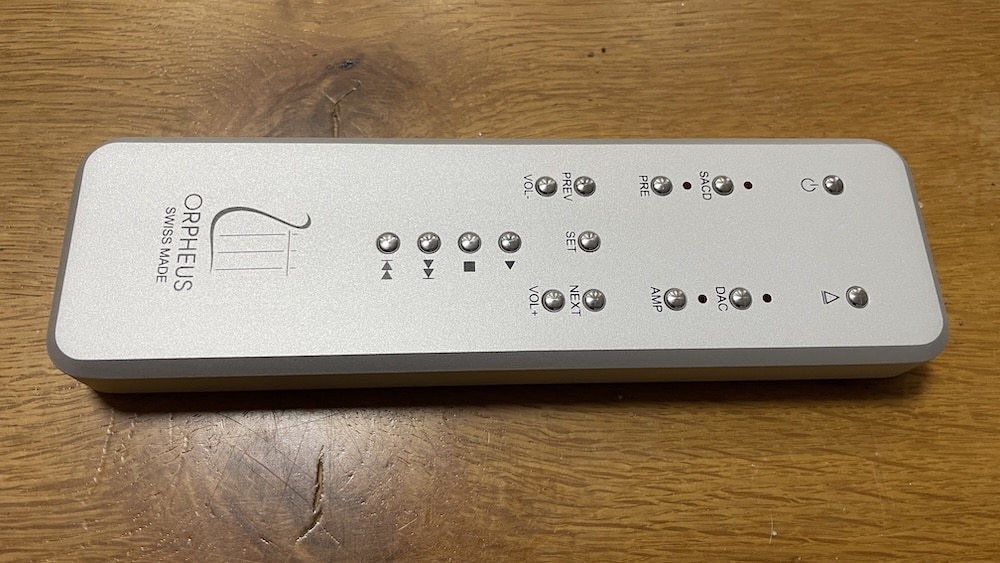
Overall, the user experience with the A Four I200 is simple, intuitive, and very user-friendly. The amplifier is designed so that the user essentially needs to do just two things: select the desired input and set the volume – and from that point on, simply focus on the music.
The Listening Test
For the listening test, the Orpheus Lab A Four I200 was connected via XLR cables to the MSB Discrete DAC. To minimize the need for constant cable swapping, I asked Guy Raguan to provide an additional pair of XLR cables. The pair I received was the Jorma Duality model (the Jorma brand is also represented in Israel by Raguan Audio). The source was the Nagra Streamer, and the speakers were my YG Acoustics Vantage 3, connected to the amplifier using QED XT25 speaker cables. As usual, the full system details can be found at the end of the article.
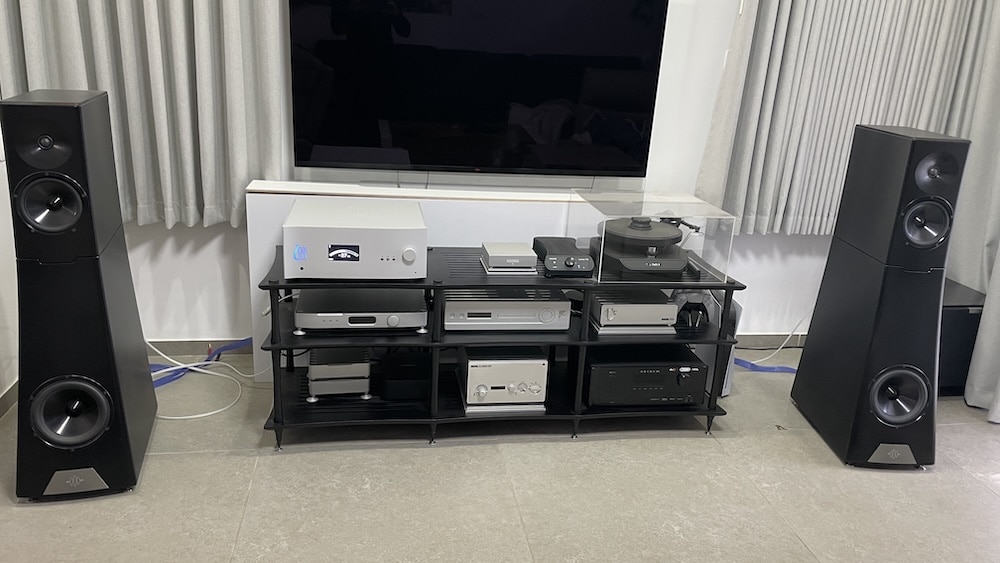
During the first few days I simply listened freely, without focusing on specific test tracks, as I usually prefer to do when getting acquainted with new equipment. I listened to several jazz albums as well as genre-based playlists generated for me by Roon.
The first characteristic that caught my attention was the amplifier’s sense of power. There are countless articles and videos online discussing “how many watts you really need,” and the common conclusion is usually “not that many.” In my view, the reality is far more complex. The result depends on many factors: the quality of the amplifier, the sensitivity of the speakers, the complexity of the music, and more. From my experience, high-power amplifiers tend to sound more relaxed – ample power reserves allow them to operate in their optimal range, and quite often the speakers themselves sound more open and airy when driven by a powerful amplifier. Of course, power alone is not the only factor, current delivery, damping factor, and other aspects also play an important role.
In any case, from the very first moment I connected the A Four I200 to the YG Acoustics Vantage 3 speakers, I clearly felt the effects I described: powerful yet effortless playback, excellent control of the bass, and an overall impression that the speakers were operating with greater ease. Perhaps the phrase “coming to life” is slightly exaggerated – but the idea is clear.
With such a powerful amplifier it is tempting to jump straight into large, dramatic and highly dynamic tracks. However, when an amplifier is both powerful and refined, my experience is that the benefits are just as noticeable in quieter pieces. For that reason, I chose to begin with the jazz track Take the L Train (To 8 Ave.) by the ensemble Brooklyn Funk Essentials. The bass was tight, deep, and well controlled, with a strong sense of airiness between the sound layers – a clean and powerful presentation. The brass instruments were clearly separated and displayed impressive clarity in the upper frequencies. The overall dynamics were precise and highly engaging.
Another musical genre that greatly benefits from a powerful amplifier is Ambient music. In many recordings of this kind, deep bass layers create the atmospheric foundation of the piece, while numerous small sonic effects float above it and must be properly separated to be fully appreciated. A great example of this is the track Rhythm of Nature by Dominique Fils-Aimé from her recent album My World Is The Sun. The deep bass layer that envelops the piece is reproduced with remarkable cleanliness and complete ease, while the subtle effects that appear throughout the track are positioned precisely across the soundstage. The vocal sits firmly in the center, clearly separated from the music and rich in nuance. It is delivered with excellent dynamic expression: at certain moments Dominique whispers, allowing every delicate detail to be heard, before transitioning naturally into a stronger vocal delivery. The brass elements that appear in the arrangement are again reproduced with impressive clarity. The overall presentation conveys power, control, and precision, balanced harmoniously with refinement and emotion.
From there I moved to instrumental rock, choosing the title track from the album Redemption by the Brazilian guitarist Lari Basilio. The piece opens with a calm, ballad-like rhythm: the guitar is beautifully clean, the bass remains tight and well separated, and the drums sound soft and natural. In the second part of the composition the drama intensifies with a powerful guitar solo. This transition once again highlights the dynamic capability and effortless presentation of the A Four I200, which never loses control and remains firmly within its comfort zone.
When listening to the electronic track Veto by SOHN from the album Tremors, dynamics and effortlessness again stood out as the amplifier’s defining qualities. The precise placement of effects across the soundstage and the clear layering of the musical elements were particularly impressive. Interestingly, this modern, electronic and highly dynamic track also emphasizes the A Four I200’s ability to make digital music sound smooth, natural, and almost “analog” in character.
For the final two pieces of the listening test, I stopped focusing on analytical aspects of the sound and instead wanted to explore the emotional side of the presentation. The first was one of my favorite country ballads of recent years, Crazy Hearts by Wesley Dean from the album Music From Crazy Hearts. The quiet and emotional opening section suddenly feels more powerful and dynamic, making it easier to notice every detail in both the vocal and the guitar. The A Four I200 manages to inject a sense of power into the music even when the piece itself is delicate and restrained. The sound feels neutral, transparent, and precise, yet at the same time emotional – never dry or overly forceful. When the drums enter in the second part of the song, they sound clearly separated, tight, and highly detailed.
The final piece I selected was the modern classical piano composition River Flows In You by the South Korean pianist Yiruma. The noise floor here feels virtually nonexistent. The recording is reproduced with exceptional clarity, and the piano sounds precise without ever becoming overly tight or dry. Instead, it flows with remarkable air and naturalness, conveying the true essence of the composition. This is a rather intimate piece, and the A Four I200 does not exaggerate it, but rather presents its proportions faithfully – another quality I consider very important.
If I summarized the design language of the Orpheus Lab A Four I200 in a single word – elegance – then I would also summarize its sonic performance in one word: confidence. This word, however, deserves a bit of explanation. The A Four I200 inspires a great deal of confidence in its ability to extract the full potential from the speakers, to reproduce every detail of the music, and to deliver its full dynamic range – no matter how demanding the recording may be.
Comparison with the Nagra Classic Int
In the final part of the listening test, I compared the Orpheus Lab A Four I200 with my personal amplifier, the Nagra Classic Int – an especially interesting comparison in my opinion. These are two impressive Swiss amplifiers, yet they represent very different philosophies in almost every aspect, from their external design to the engineering approach behind their construction.
In terms of pricing, the Nagra Classic Int is positioned slightly higher (particularly when its dedicated vibration control base plate is taken into account). However, the two products ultimately sit within the same general price range, and I believe that anyone looking for an integrated amplifier at this level could realistically find themselves choosing between them.
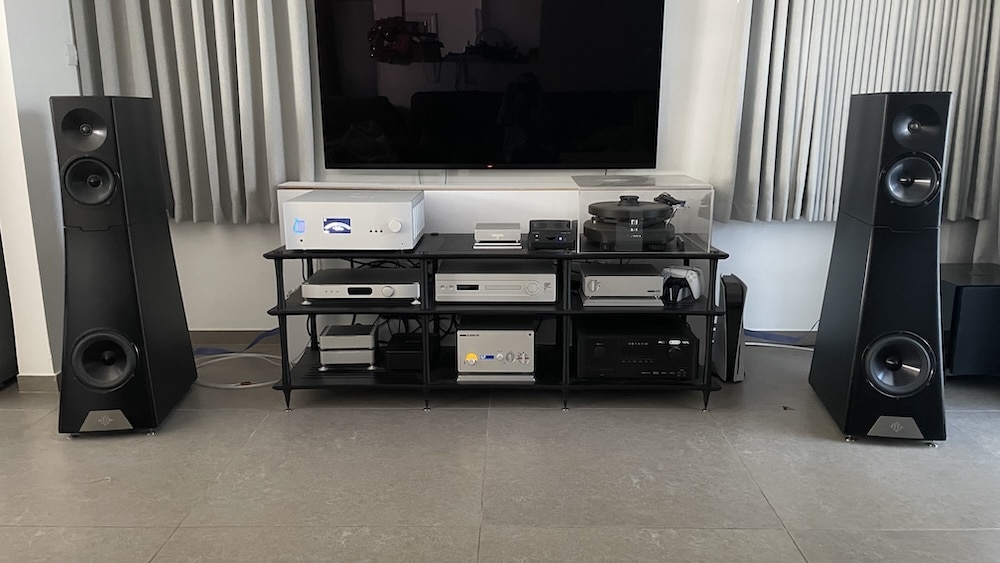
To evaluate how the two amplifiers perform against each other, I returned to two tracks that I had already used earlier in the listening test: one primarily for assessing technical aspects, and the other focusing more on emotional expression and musicality. Switching between the amplifiers required replacing two sets of cables – the XLR cable between the DAC and the amplifier and the speaker cables – so the comparison was not completely instantaneous. As a first step, I used the dBMeter application to match the playback levels of both amplifiers to approximately 80dB in order to maintain the most consistent conditions possible. I then listened to both tracks through the Orpheus, switched to the Nagra, and finally returned once more to the Orpheus.
The first track was Rhythm of Nature by Dominique Fils-Aimé. n the bass region, the Orpheus sounded tighter and more punchy, and the small background effects were better separated and easier to identify. In contrast, the presentation of the Nagra Classic Int integrated amplifier placed a clearer emphasis on the vocal: it occupied more space at the center of the stage, resulting in a presentation that sounded somewhat softer and perhaps slightly more natural. On the other hand, the overall impression was of slightly reduced dynamics and less overall impact.
The second piece was Crazy Hearts by Wesley Dean. In the opening section of the track, where only the guitar and vocal are present, the Orpheus Lab A Four I200 integrated amplifier presented clearer separation of the guitar, with greater dynamics and an increased ability to reveal fine details. The Nagra, on the other hand, reproduced the same moment with a bit more intimacy: the vocal sounded smoother and more integrated with the music, though this came at the expense of slightly less distinct separation of the guitar.
In the second part of the track, when the drums enter, the Orpheus demonstrated an advantage in terms of air and bass control. By contrast, the presentation of the Nagra remained softer and more rounded, with a tonal character that somewhat recalls tube amplifiers and a stronger focus on delivering the vocal with smoothness.
As can be seen, and as is also reflected in the design and engineering philosophies of the two products – there is a clear difference in sonic performance between the amplifiers. The greater power of the Orpheus Lab A Four I200 integrated amplifier allows it to extract more of the potential from speakers such as the YG Acoustics Vantage 3, producing a more dynamic and powerful sound, while still maintaining a strong sense of emotional engagement with the music. The Nagra Classic Int integrated amplifier, on the other hand, offers a more refined presentation with a stronger emphasis on flow and smoothness, albeit at the expense of some dynamics and air. Ultimately, the choice between the two amplifiers is therefore not a matter of quality, but rather of preferred presentation and system matching.
Summary
This was the first time I had the opportunity to evaluate a product from the Swiss company Orpheus Lab in my own home system. There is no doubt that today’s audio market is saturated with brands – perhaps even excessively so. For anyone looking to build a high-quality audio system, the sheer variety can quickly become overwhelming, with countless manufacturers and possible combinations between them. Yet within this sea of respected and well-established brands, there are occasionally products that manage not only to perform at a very high level, but also to truly stand out. The integrated amplifier Orpheus Lab A Four I200 integrated amplifier is one such product.
From a design perspective, this is a large and heavy amplifier, but it is clear that considerable thought has gone into every detail. The result is an appearance that feels elegant, clean, and impressive. However, where the A Four I200 truly excels is, of course, in its sonic performance. This is an exceptionally powerful amplifier, capable of driving almost any loudspeaker on the market with ease. Its sonic character is neutral and precise, yet the real charm lies in the fact that alongside its power and accuracy, the amplifier also maintains a sense of musical flow and smoothness – avoiding the trap of sounding dry or overly analytical.
In fact, the Orpheus Lab A Four I200 integrated amplifier is probably the highest-performing integrated amplifier I have reviewed in my system so far. It also reinforces one conclusion I often return to: even for those aiming at an ultra high-end system, an integrated amplifier can still be an excellent solution – and sometimes even the most logical and cost-effective choice.
Therefore, if you are aiming for truly high-level sound performance and have assumed from the outset that you would need to build an expensive system based on separate components, it may be worth pausing for a moment and considering the Orpheus Lab A Four I200 integrated amplifier. You may well discover that an integrated amplifier can deliver exactly the kind of musical result you were hoping to achieve.
Price: 62,000 NIS
Warranty: 2 Years
Importer: Raguan Audio
The system I used for the review:
Speakers : YG Acoustics Vantage 3
DAC: MSB Technology Discrete DAC with two external power supplies
Streamer: Nagra Streamer
Integrated amplifier for comparison : Nagra Classic Int
Cables :
XLR cable between the DAC and the amplifiers: Jorma Duality & Nordost Blue Heaven
Coaxial cable between the streamer and the DAC: Nordost Blue Heaven
Speaker cables : QED XT25 & Nordost Blue Heaven
Power:
Power cables for the amplifier (Nagra), the streamer and the DAC: Nordost Blue Heaven
Power Distribution Block : QBASE QB8 Mark II
Power cable for the distribution block: Nordost Red Dawn
HiFi Rack: Quadraspire SV3T Performance