

This time, we had the chance to review the PrimaLuna EVO 200 tube integrated amplifier. After being thoroughly impressed by the flagship EVO 400 model last year, the question is—can this mid-range model capture the same magic? Let’s find out.
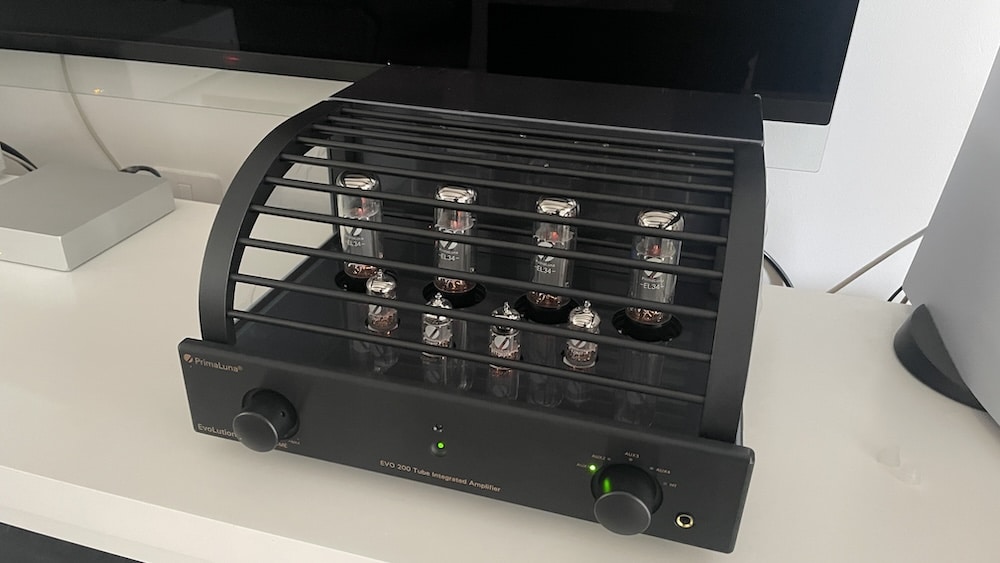
We’d like to thank Audio Video, the official importer of PrimaLuna in Israel, for providing us with the amplifier for this review.
Bottom Line
The PrimaLuna EVO 200 features a retro-modern design, excellent build quality, and a smooth, addictive sound

Liked
- Clean and precise design blending retro and modern elements
- Straightforward user experience with no unnecessary complications
- Auto Bias system and tube failure indicators reduce the intimidation factor of tube gear
- Surprisingly powerful amplification, capable of driving even less efficient speakers
- Warm, spacious, three-dimensional, natural, smooth, and highly enjoyable sound

To Improve
- No balanced XLR input
- Lacks a subwoofer output, unlike the higher-end models
About PrimaLuna
PrimaLuna is a Dutch company founded in 2003 by Herman van den Dungen, a long-time distributor of high-end audio equipment. Herman gathered around him a team of experienced professionals, including Marcel Croese (formerly of Goldmund), Dominique Chenet (formerly of Jadis), and tube guru Kevin Deal (whom you may recognize from the YouTube channel of the American store Upscale Audio). Together, they shaped the company’s philosophy: to create the best products possible while maintaining price consciousness.
According to the company’s website, the name PrimaLuna comes from the Italian language—Herman’s grandfather was of Italian descent—and it means “first moon.”
PrimaLuna’s current product line is called Evolution and includes four models of integrated amplifiers, four preamplifiers, and four power amplifiers. Somewhat confusingly, all models are named EVO 100, EVO 200, EVO 300, and the flagship EVO 400—whether it’s an integrated amp, a preamp, or a power amp. In addition, the lineup includes the EVO 100 DAC and a phono preamp, which is also called EVO 100.
Under Test: PrimaLuna EVO 200
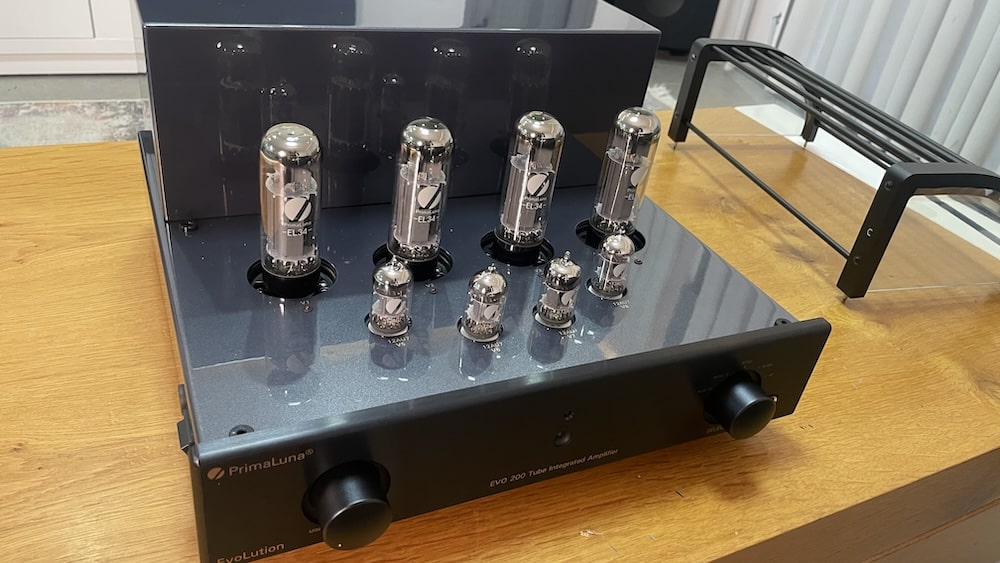
The PrimaLuna EVO 200 is the mid-tier model in the Evolution series, positioned above the entry-level EVO 100 and below the EVO 300 and 400 models. It is a fully tube-based integrated amplifier—the preamp section uses four 12AU7 tubes, while the power amp section is based on four EL34 tubes. The EVO 200 also supports KT88 tubes for the power stage, giving you the flexibility to experiment and find the type that best suits your preferences.
Since these two types of tubes require different bias levels, the amplifier includes a switch that lets you toggle between low and high bias. With the EL34 tubes, which come pre-installed, the correct setting is Low.
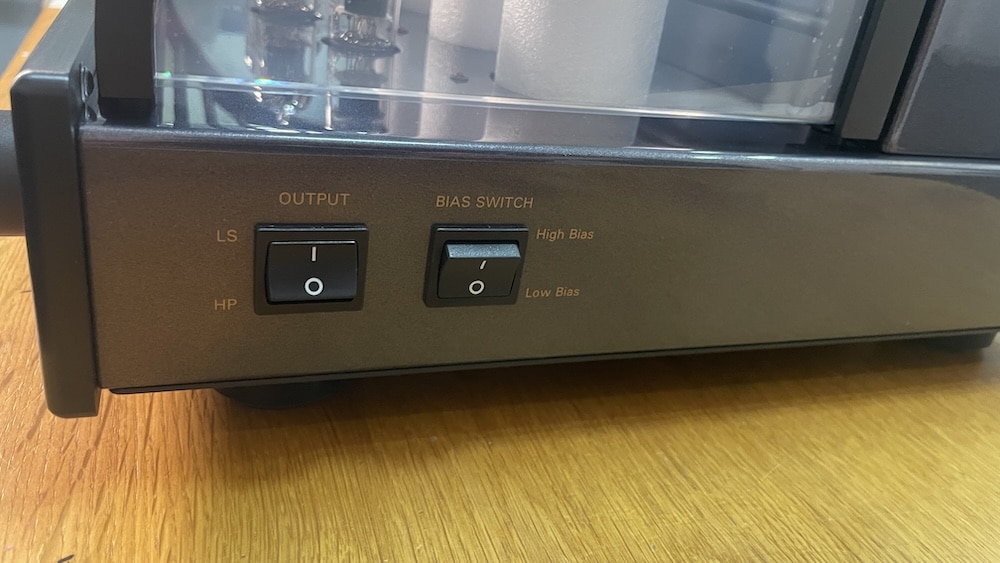
The output power of the amplifier is 44 watts per channel when using EL34 tubes, or 45 watts with KT88 tubes.
On PrimaLuna’s website, you can find a comparison chart that outlines all the differences between the four models in the series:
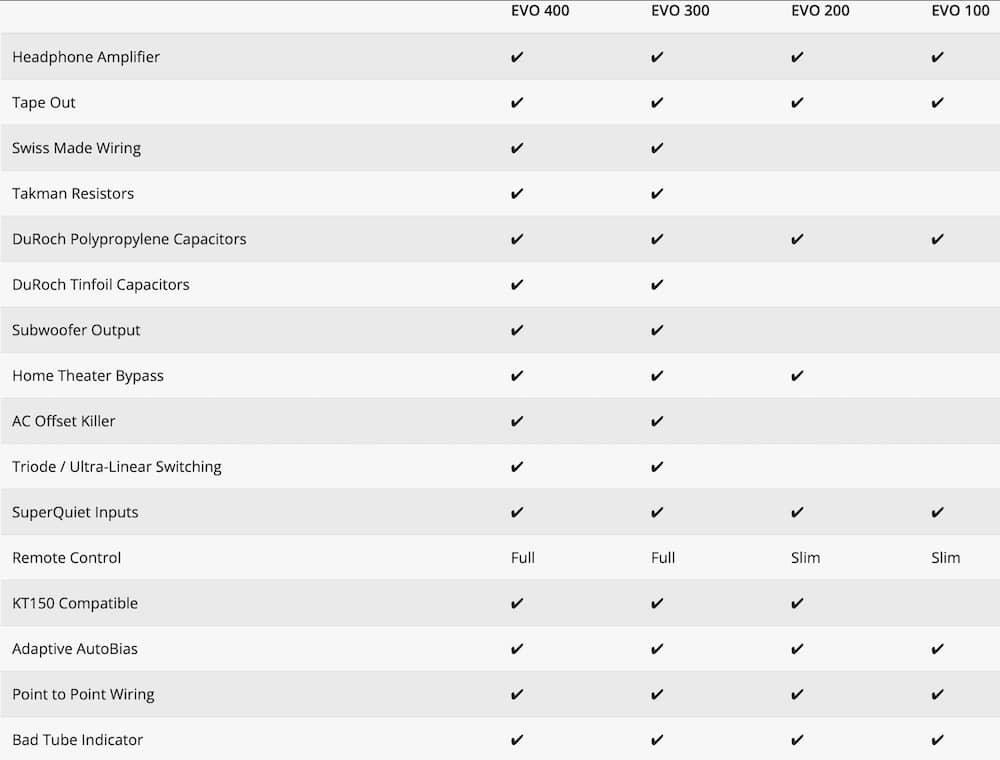
The EVO 200 comes equipped with most of PrimaLuna’s key proprietary technologies, including the unique Adaptive Auto Bias circuit. This circuit operates outside the audio signal path and continuously monitors and adjusts the bias of each tube in real time. Not only does this eliminate the need for manual bias adjustment, it also extends the lifespan of the tubes and significantly reduces distortion.
Another important feature is the tube failure indicator system. If a tube becomes faulty, the amp automatically enters protection mode and a dedicated LED shows exactly which tube needs replacement. In addition, the Power Transformer Protection circuit shuts down the amplifier if the output transformer overheats.
These three protection mechanisms greatly reduce the concerns that many new users have when entering the world of tube amplification—users who love the warm tube sound but worry about maintenance and adjustments.
Two features missing from the EVO 200 compared to the higher-end models are the AC Offset Killer (which reduces transformer hum) and the ability to switch between Triode and Ultra-Linear modes (the EVO 200 operates exclusively in Ultra-Linear mode). Beyond that, the differences are mostly in the quality of certain components, such as internal wiring and capacitors, and the absence of a subwoofer output.
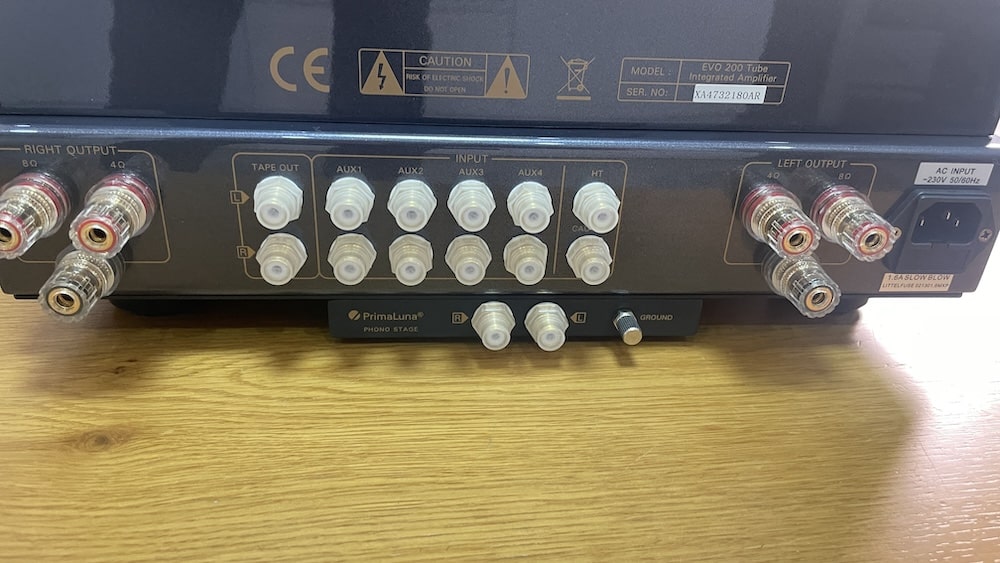
In terms of connectivity, the PrimaLuna EVO 200 offers four RCA inputs, plus an additional HT Bypass input for integrating into a home theater system (allowing the EVO 200 to be used as a power amp only). On the output side, there’s a Tape Out and a headphone output. The only input I felt was missing is a balanced XLR input.
The unit we received for review came with the optional phono module, which adds an MM phono input discreetly integrated into the lower rear panel in a fully shielded enclosure.
The speaker terminals include a single negative binding post and two positive ones—one for 8-ohm speakers and one for 4-ohm speakers—so make sure you connect them properly.
The PrimaLuna EVO 200 also features a high-quality headphone amplifier that utilizes the amp’s main tubes, rather than relying on a separate headphone circuit. This means you get the full sonic character and quality of the EVO 200 whether you're listening through speakers or headphones. Switching between the two is done via a toggle located on the right side of the amplifier, next to the Bias switch.
Like all PrimaLuna products, the EVO 200 features hand-wired point-to-point connections.
The dimensions of the PrimaLuna EVO 200 are 205 mm high, 365 mm wide, and 405 mm deep. The amplifier weighs 24 kg.
Design and Build Quality
The Unboxing video:
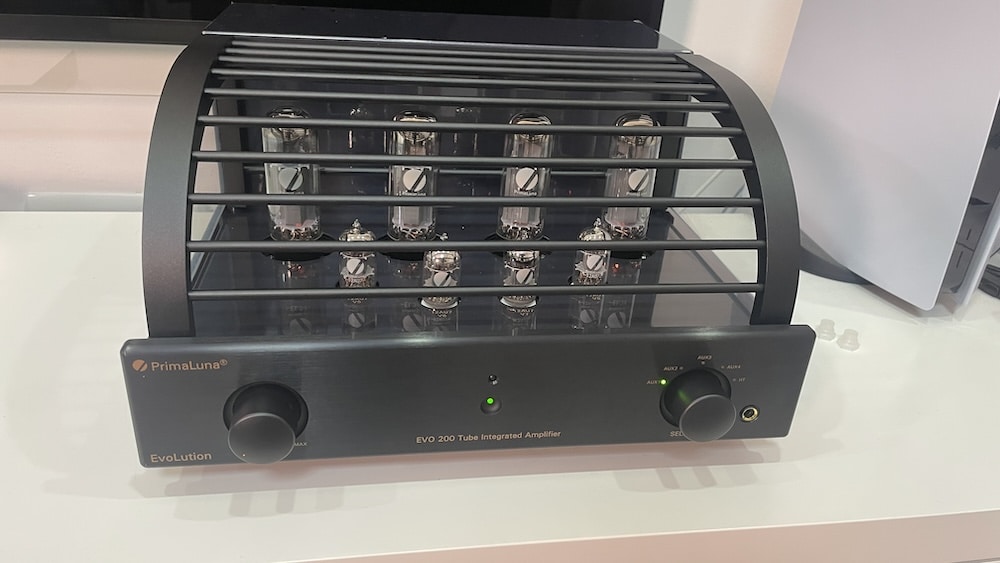
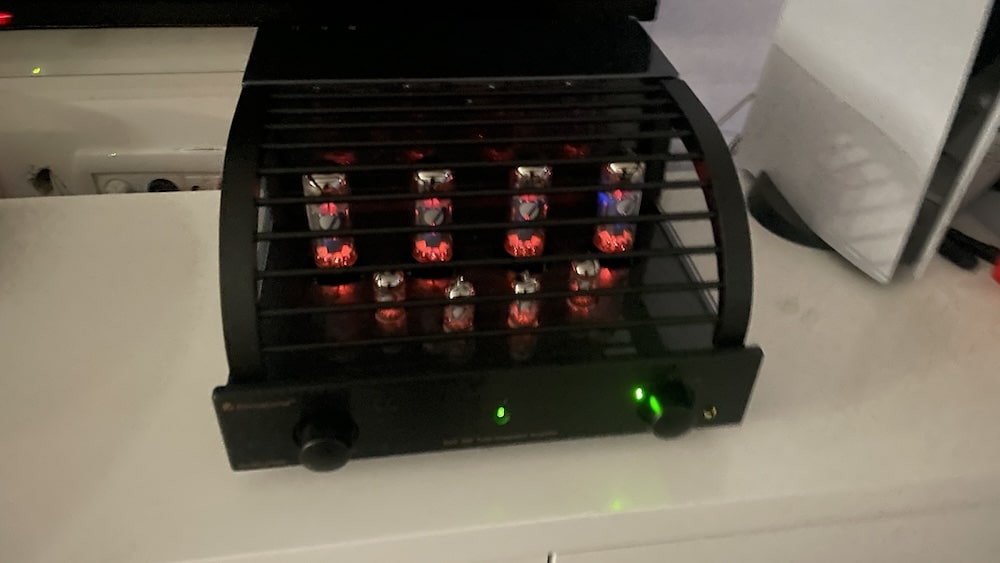
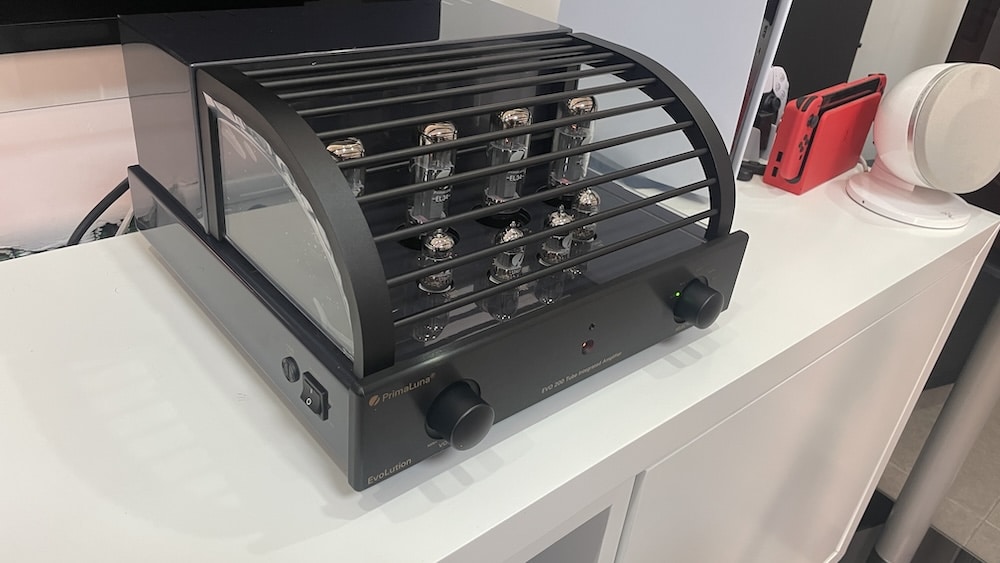
The PrimaLuna EVO 200 features the classic design of tube amplifiers, with a metal plate that holds the rear inputs and front control switches, while the tubes and transformers are mounted on top of it. Besides the nostalgic look, this design also has functional logic, as this positioning of the tubes provides them with maximum ventilation, unlike more modern designs that enclose the tubes in a sealed box.
The tubes are protected by a beautifully rounded cage, which softens the overall size of the amplifier and gives it a more modern and lighter feel. The cage also has glass sides and can be easily removed if you need to replace a tube or if you prefer not to use it.
PrimaLuna products are available in two finishes: silver and black. I generally prefer silver finishes, but I must admit that the black finish is pleasant, well-executed, and allows the device to blend more easily into the room. It draws less attention compared to the silver finish.
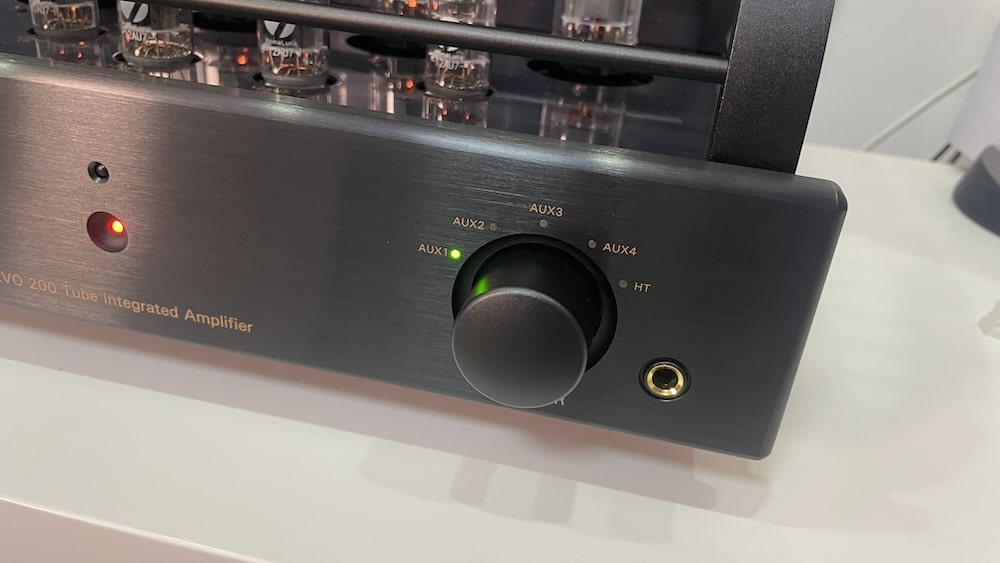
In the center of the front panel, you'll find the indicator light that glows red when the amplifier is turned on, and turns green once it warms up to indicate it's ready to play. On the left side is the volume knob, and on the right is the input selector, which includes a green light to indicate the selected input. The names of the inputs are clearly displayed on the selector.
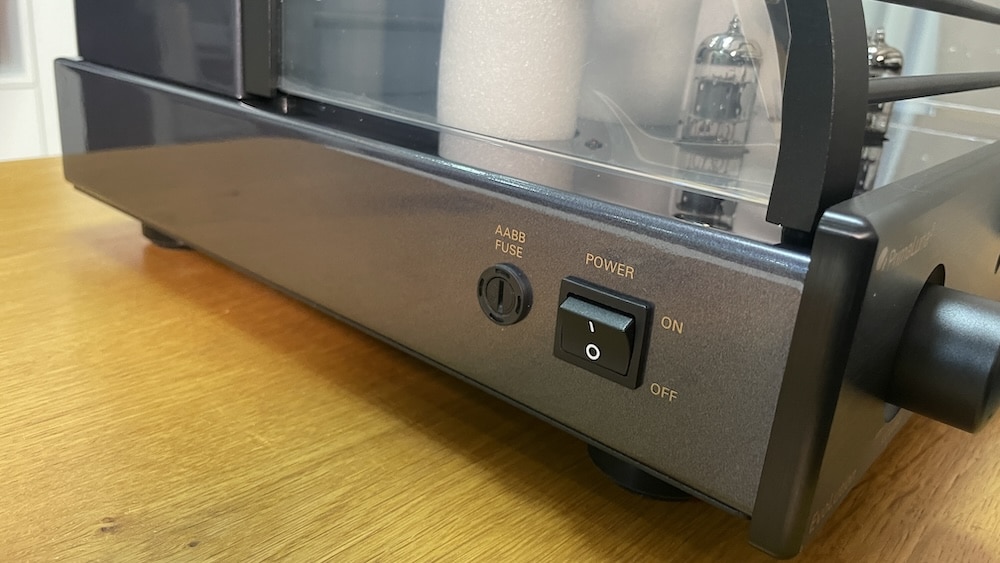
The power switch is located on the left side, while on the right side are the switches that allow you to select whether you're using speakers or headphones, as well as the Bias mode selector, both of which we have already mentioned.
Without any unnecessary embellishments, with precise and smooth finishing work, I found the build quality here to be nothing short of excellent.
In the evening hours, the amplifier's tubes emit a pleasant and warm orange-brown glow. What more could you ask for from the design of a tube amplifier?
Usability
The people behind PrimaLuna have extensive experience in the sales and marketing of audio products. Over the years, they’ve undoubtedly met thousands of customers and encountered countless products. All this experience is reflected in the design of the company’s amplifiers. The user experience here is incredibly precise. Everything is accessible and clear, and is behaving exactly as expected. You power on the amplifier, select the desired input, set the volume, and you're done—all that’s left is to enjoy the music.
In addition to the straightforward everyday experience, I must, of course, mention again the protection mechanisms, the indicator for faulty tubes, and the Auto Bias system. These features are designed to reduce the headaches for users and allow them to listen to music with minimal concerns.
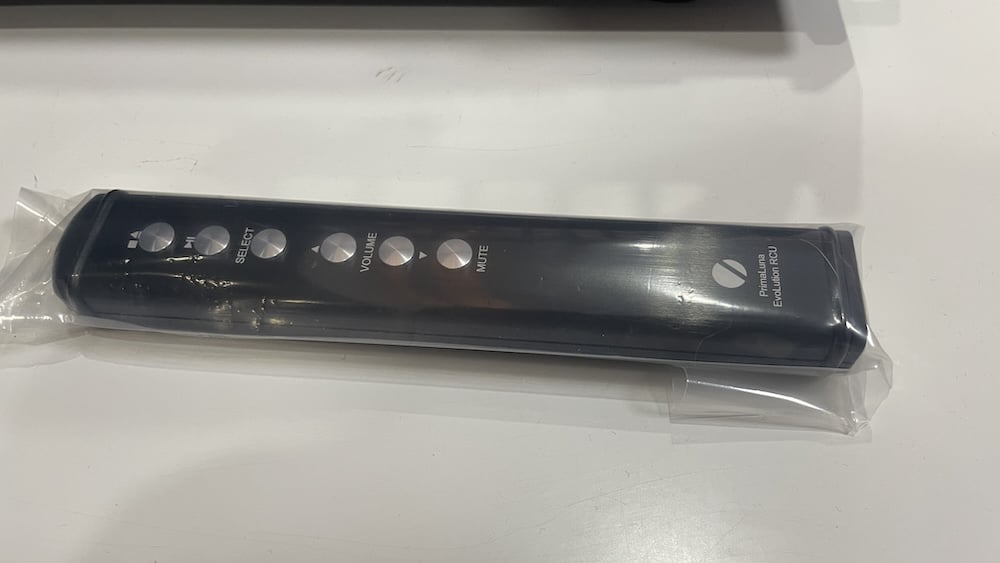
The PrimaLuna EVO 200 comes with a thin metal remote control, which has excellent build quality. The remote allows you to switch inputs and adjust volume. Since I only used one input throughout the review, I didn’t feel the need to use the remote at all.
The Listening Test
The listening test for the PrimaLuna EVO 200 was quite varied, including two pairs of speakers and a comparison with another amplifier. As usual, the full list of equipment used is provided at the end of the article.
With the Fyne Audio F1-8 Speakers
Along with the PrimaLuna EVO 200, we also received for review the flagship bookshelf speakers, Fyne Audio F1-8, which are also imported by Audio Video (read our full review of the Fyne Audio F1-8).
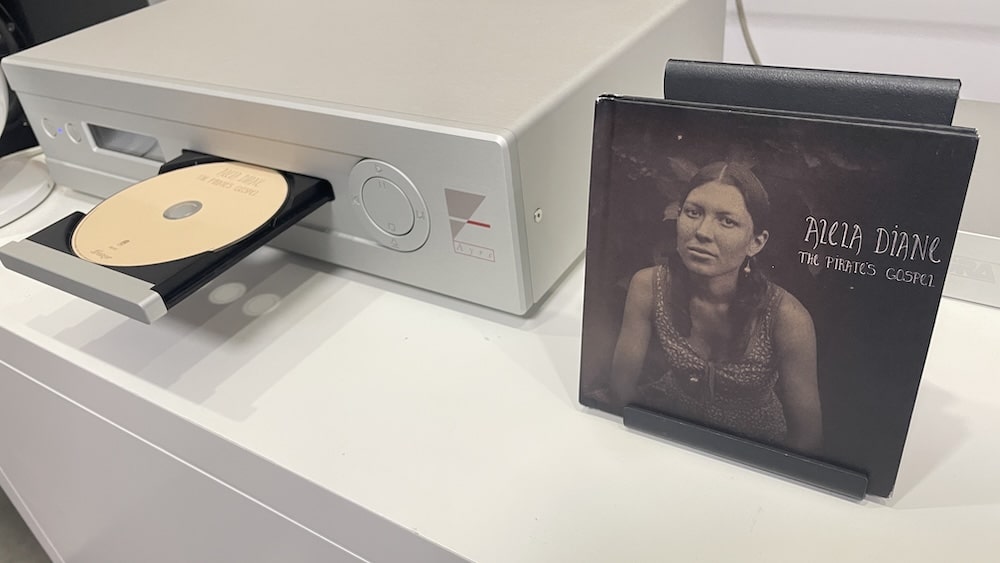
Since the PrimaLuna EVO 200 does not have an XLR input, I couldn't connect to it my regular DAC, the MSB Discrete DAC. Therefore, throughout the review, the source I used was the CD player with the streaming module, Ayre CX-8, which I used to stream content via Tidal Connect.
The term "musical" is always a problematic description term to use in reviews, as it is entirely subjective. In recent years, I increasingly associate the term "musical" with the combination of tube amplification and high-efficiency speakers. There's something about the warm, smooth, and pleasant sound of tubes combined with speakers that play effortlessly, that creates a sound full of emotion that you just want to listen to more and more. This is a sound signature that is different from the modern sound signature, which prioritizes dynamics, transparency, and detail. I would describe the combination of the PrimaLuna EVO 200 and the Fyne Audio F1-8 as smooth and emotionally engaging.
For example, in the track Glow by Manu Katché from the album The Scope, the result is a smooth sound with natural dynamics, warmth in the bass, and a softness that is surrounding the drumming. The vocals are centered and well-separated.
In the folk album The Pirate's Gospel by Alela Diane, I experienced a precise reproduction of effects like the clapping in the title track or the whistling in Foreign Tongue. The soundstage is wide and three-dimensional, with a calm and non-aggressive feel. The sound isn't too forward, but rather spreads across the depth of the stage. Alela’s distinctive vocals display a good level of detail, the highs are rounded, and in my opinion, the background vocals are given more prominence than, for example, the guitar strumming. So, there's a tendency in this combination of the PrimaLuna and Fyne Audio to emphasize the vocal element.
The album that brought out the best of the combination between the PrimaLuna Evo 200 and the Fyne Audio F1-8 was 707 by the German new-jazz ensemble, Nighthawks. In this album, which blends jazz with funk alongside subtle electronic elements, I experienced a softened sound that highlights the key instruments, such as guitar and brass instruments. This clarity is fantastic, and the presentation was smooth and emotionally engaging. In the track Portree Liberty, the brass instruments are delivered with wonderful smoothness and grace.
Another highlight occurred in the ballad The Lord by Sophie Zelmani. The guitar is rendered with incredible clarity and delicacy, with a great deal of silence (or layers of air, if you will) between each strum. The vocal performance is beautifully separated, and the refined, soft, and enveloping presentation comes across in a particularly emotional way.
`Comparison VS Nagra Classic Int
This is certainly not a fair comparison given the price difference between the two amplifiers. Additionally, the Nagra amplifier was connected to the MSB Discrete DAC, while the PrimaLuna Evo 200 was connected to the Ayre CX-8 CD player and streamer. However, this comparison can serve as a reference point, which is why I decided to make it.
In the piece Pesa, which combines violin with electronic music, composed by Italian violinist Lino Cannavacciuolo, I felt that the Nagra and MSB pairing provided a larger soundstage, with more airiness. In contrast, the PrimaLuna and Ayre focused on a smoother and softer presentation, with slightly fewer details and less precision in terms of object placement on the stage. The PrimaLuna’s presentation, however, includes admirable dynamics, and the violin comes through cleanly and impressively.
In the piece When Nations Collide by the British rock band Mostly Autumn from their new album Seawater, I received a clean and moving vocal transfer through the PrimaLuna. After the intro, the guitars enter with good dynamics without compromising the clarity of the vocal. The guitar solo comes through with enough power, and the presentation is soft and refined, complementing the rock ballad beautifully. Through the Nagra and MSB, there is a bit more detail, especially in the quieter sections, with slightly better separation between the vocal and guitar, and the soundstage is wider. The Nagra's presentation is more balanced, with less warmth and smoothness.
In summary, in terms of audiophile traits like soundstage size, dynamics, balance, and detail, the Nagra and MSB system has the advantage. However, when factoring in the price difference, the PrimaLuna EVO 200 certainly puts up a strong fight. Additionally, the EVO 200 has a warm and smooth character, which I found especially enjoyable.
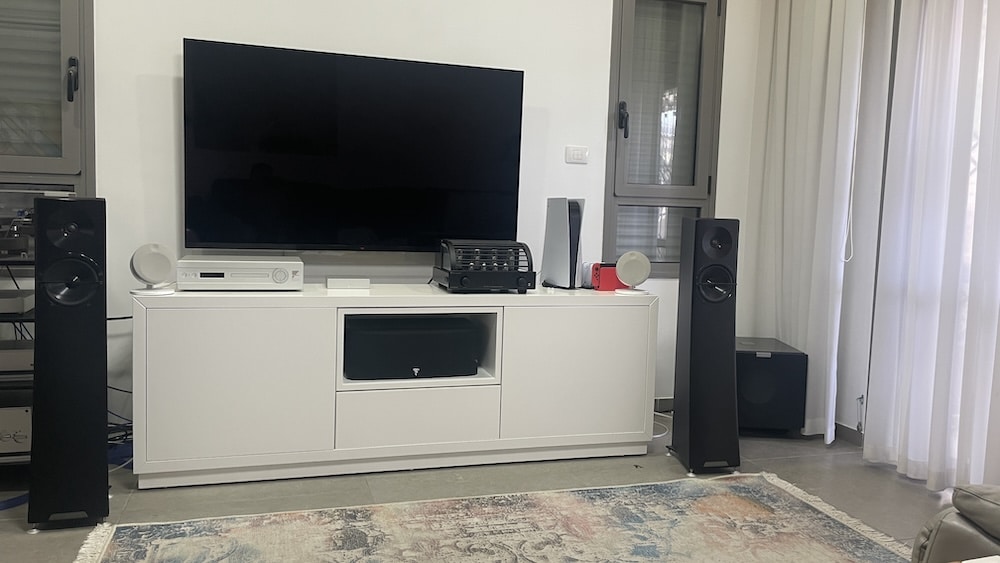
With the YG Acoustics Carmel 2 Speakers
For the first segment, I returned once again to the piece "Portree Liberty" by Nighthawks. My first impression was absolutely jaw-dropping. The sound is incredibly airy, dynamic, wrapped in a pleasant and enjoyable warmth, most satisfying. The bass is punchy and full, and the sound is completely smooth, without any hint of harsh treble, midrange, or bass—just a natural and homogeneous result.
The second piece I chose was "Elders and Betters" by Emily Allison and Boris Schmidt from the album Treehouse Days. This is a high-quality audiophile recording, and the PrimaLuna Evo 200 showcases this by recreating a vast, three-dimensional soundstage. The vocal has a church-like effect, conveyed clearly, while the bass is soothing, warm, and soft. The level of detail is excellent, though a bit more tightness in the bass would have been even better.
For the final track, I chose something with a bit more energy, so I turned to the iconic electronic dance album Random Access Memories by the French duo Daft Punk. This time, I selected the track "Beyond." The opening features classical-cinematic music with violins, and through the Evo 200, there is wonderful dynamics and a high level of clarity. When the electronic bass enters, it receives a pleasant addition of warmth. Here too, I feel there's a slight sacrifice in tightness to achieve a natural and pleasant sound, and I definitely appreciate this trade-off, as what you gain is excellent musicality, which is how I define it.
This part of the test demonstrated two interesting points. First, how dry numerical data doesn't reveal the whole story. The modest amplification figure of 44W per channel, with the speakers' sensitivity of 87dB and a nominal impedance of 4 ohms, doesn't sound like a recipe for success. In reality, even at less than a quarter of the volume, I reached an average of about 75dB with peaks of 85dB, which is the volume I enjoy listening at. There was no noticeable strain from the PrimaLuna Evo 200; in fact, it easily controlled the speaker and provided smooth sound with impressive dynamics and bass.
The second point is about balance and synergy. On paper, the Fyne Audio F1-8 speakers, with their high sensitivity and warm, smooth sound character, are the natural match for the PrimaLuna Evo 200. For those who enjoy this type of sound, it's certainly a great match. For me, it was a case of too much similar character, and I preferred the performance of the Evo 200 with the YG speakers, which have a neutral and precise sound character. This combination gave me the best result in this test, in my opinion. The YG's character added more detail and accuracy to the Evo 200, while the warm and soft character of the amplifier contributed refinement and emotional depth to the precise sound of the YG.
*To conclude the listening test, I should note that the phono module was not tested here, as it officially supports only MM cartridges.
Value for Money
When I assess the differences in features between the four PrimaLuna models, if the subwoofer output feature isn’t important to you and your speakers aren't particularly difficult to drive, in my opinion, the PrimaLuna EVO 200 easily offers the best value for money. It's an amplifier that includes exactly what you need and no more. Even if the components in the higher-end models are somewhat better, I believe that for most people, the Evo 200 is the most suitable amplifier.
On the other hand, the price difference between the Evo 200 and the flagship Evo 400 is not particularly high in high-end audio terms. I just want to point out that the Evo 400 has a larger number of tubes, for example, it has twice the power tubes, which could lead to higher maintenance costs.
Summary
The PrimaLuna EVO 200 features a design that blends retro with modern elements, coupled with precise build quality. The word "precise" also applies to describing the user experience with the Evo 200. The extensive experience of the people behind PrimaLuna in working with end customers is evident here in the design of a product that aims to give music and sound enthusiasts exactly what they want.
The sound signature of the amplifier is exactly what you would expect from a quality tube amplifier—slightly warm, with a big, three-dimensional sound, full of naturalness, softness, and emotion.
In conclusion, the PrimaLuna EVO 200 easily meets expectations in every possible parameter, making it an excellent value for money.
When reviewing tube equipment, I usually explain why this technology is still relevant today. After listening to amplifiers like the PrimaLuna EVO 200, those explanations seem unnecessary. This technology has a unique charm, and I’m increasingly convinced that the path to a truly 'musical' result—one that makes you want to listen more and enjoy the music more—should include tube electronics to some extent.
Price: 21,379 NIS
Warranty: 1 year
Importer: Audio Video
The system I used for the review:
Speakers: Fyne Audio F1-8 & YG Acoustics Carmel 2
CD player and Streamer: Ayre CX-8
A System for Comparison:
DAC: MSB Technology Discrete DAC with dual power supplies
Integrated Amplifier: Nagra Classic Int
Streamer: Nagra Streamer
Cables:
XLR cable between the DAC and Amp: Nordost Blue Heaven
AES/EBU cable between the CD and DAC: Shunyata Research Alpha V2
Coaxial cable between the streamer and DAC: Nordost Blue Heaven
Speaker cables: QED XT25 & Nordost Blue Heaven (in the system for comparison)
Power:
Power cables for the Streamer, amplifier (Nagra) and DAC : Nordost Blue Heaven
Power Distribution Block : QBASE QB8 Mark II (to it the Streamer, amplifier – Nagra, DAC and CD player were connected)
Power cable for the distribution block: Nordost Red Dawn